Living the Lie; Seeking the Truth in the Digital Age

From a Sermon given Spring Equinox Worship Service March 2017

Last fall we gathered for a worship service that occurred right after the United States presidential election.  During that service I talked about the perfect pictures that had dominated the election process and the need for us to construct a new narrative based on greater Truth.  Good example of:  be careful what you pray for.

Three months later our mass media and our social media are flooded with stories of people trying to figure out what is true and what is not true.  As usual, many people are trying to impose their truths on other people.  There is nothing new about this.  The NEW part is that we are now arguing about who has the right to define truth for our society, our collective life.  Many or most of the institutions that we formally accepted as the truth-sayers are now being discredited.

Lots of folks have lots of opinions about whom to trust and whom to distrust as sources of information; as well as what we should all be paying attention to and what should be ignored.   Newspapers and television shows are being blasted right and left over the choices they make either to report or ignore various issues or events, the choices within each story of what to mention, what to focus on, as well as what their comments should actually be.  Academic institutions, law enforcement, medical professionals and other scientists, segments of our population that have been a go-to place for many decades, are now being scrutinized at best, vilified at worst.  Depending on who you talk to, the scientific perspective is either under attack, or finally being put in its place.   Educational systems from preschool to college are being gutted and their professionals viewed as having little or no value.  And of course, everyone seems to think the government is lying, even people in the government.

Suddenly the deep divisions within our country are not just about governmental policies and other surface politics.  Rather, they are about the very nature of our reality, our basic most understanding of the truth.  In the process of figuring out who we want to trust, we’re getting inundated by new terminology like fake news, alternative facts, gas lighting, click bait headlines, and the like.  What’s going on?

In my opinion, we’re right on track.  What I mean by this, is that the fights that are erupting everywhere in our culture these days, from a spiritual perspective are predictable; are vital, even necessary.

We are in the midst of a HUGE epistemological cultural war.  Epistemology is a word that comes from the field of philosophy.  Epistemology is about investigating human knowledge.  Epidemiologists try to understand how we know what we know.  What methods do we use to arrive at the truth, and what are the limitations of said methods?  All useful things to study, especially these days.

There are many ways of understanding that the word Truth, but the Truth that is most of interest to me, the Truth that I hope to bring us back to, the Truth I pray you will have a better understanding of when you leave here today, is something I sometimes call Truth with a Capital “T.”  In other words, God.

As human beings, it seems to be our lot in life to try and make sense out of things beyond our reach.   I am always amazed at the hubris of people who think they know everything, have all the answers for everyone around them.  I am especially astonished by the religious leaders who think they can speak for God when they tell other people what to think or do.  Humans like to imagine that we understand God; and don’t get me wrong, it’s important that we try.  But in my opinion we also need to develop the humility to understand the limitations of our knowledge base.  We are a part of something bigger that contains and knows the whole of the cosmos.  We are part of God, but we are not God in its totality.

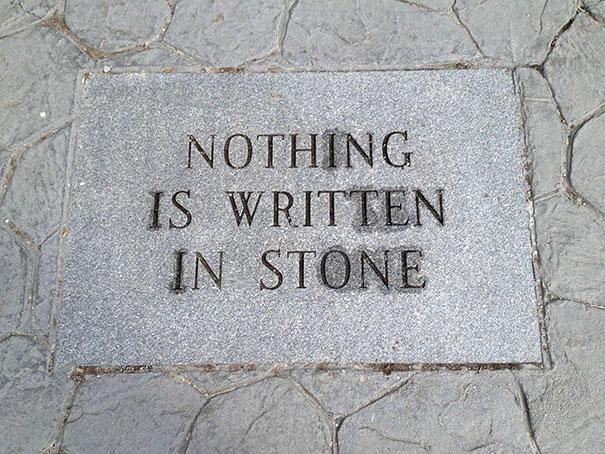
The Vedic religions is one of the spiritual traditions that have most clearly addressed the nature of reality.  In Hinduism, the world is referred to as the “Maya.”   The Māyā is a Sanskrit word that means the “magic show, the illusion where things that are before us not what they seem.”   Māyā is the idea that that which exists is constantly changing and thus ultimately  unreal.   God is the only thing that doesn’t change, the only reality.   Written in StoneEvery aspect of what we think of as the physical reality is really just a snapshot in time, seen from one particular camera or lens.  There are as many versions of the truth as there are forms of life in our universe, which is beyond what we can count or measure.  Bottom line:  Truth belongs only to our Creator.
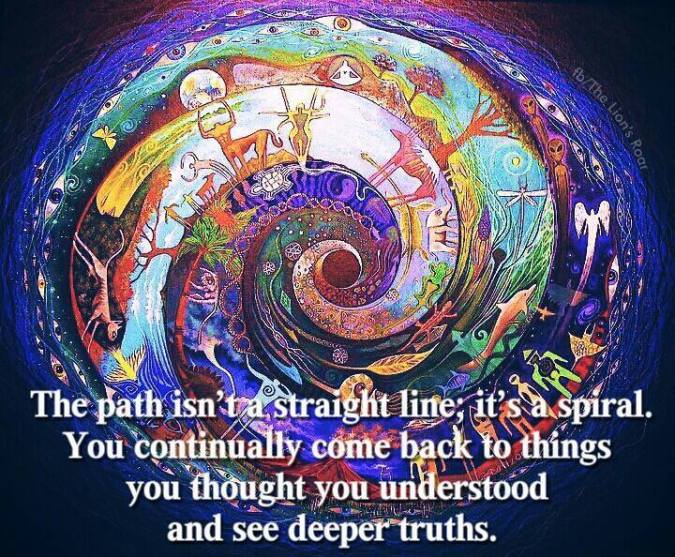
As individuals we are but a piece of the puzzle.  A chip off the cosmic block.  We are not the entire puzzle; nor can we even understand the whole puzzle while incorporated in the flesh.  Here at the Church of the Harvest, we acknowledge this diversity of worldviews by referring to the divine by many names:  The All-That-Is, Allah, the Creator-of- Us-All, the divine, God, Goddess, the God of our Heart, Nature, the universe, etc.   Some of my favorite names for the divine are metaconcepts like Justice, Love, and Truth (with a Capital T).   For us puny humans, each of us have our own unique piece of the truth.  And it’s incredibly important to all of us that we discover and speak that truth and live that truth to the best of our ability.  Deeper TruthsSome of us are closer to knowing and living and speaking the Truth with a Capital T.  But none of us can claim to have the complete picture.
You are all healers, change agents in the great game of life.  You no doubt know that the process of healing involves stripping off the delusions about who are, stripping off the ego that protects those delusions, piece by piece, layer by layer, like peeling an onion some people say, in order to get down to the bedrock, get down to the cornerstone distortions that are keeping us from understanding our true nature.

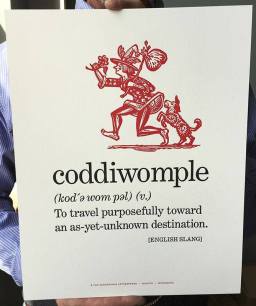
When enough people have stripped away enough old perspectives, sometimes there  occurs in society something called a paradigm shift.  A paradigm shift is when so much is changing about the basic framework that our cognitive model of how we see the world changes.  Most of you will recognize what I mean when I say that a paradigm shift is to a large collection of people such as those who make up an industry or an  entire country, what a growth period is to an individual meditator.  The U.S. has been in a rather intense and painful stripping process for many months now.  The next step, the natural progression is for us is to deal with the bedrock of how we understand our world.  We are being called to adopt a more accurate perception of reality, to come closer to the Truth.Coddiwomple
We often talk about the world of energy.  We offer opportunities for people to come to terms with their individual energy system.  We have a meditation community so that individuals can safely learn about sharing collective space with other individuals committed to being responsible about their own energy system.   But I’d like to remind you today that energy is not the only component on which you have to get a handle if you want to create the kind of world all of us desire, a world grounded in the unconditional love of the universe.  It takes a lot of power to create a world based on love, and real power takes not only energy, but also truthful information.

Power equals energy and information.  You can have a lot of energy like what happens for many bipolar individuals, but unless you have the information about how to ground that energy and work within your own body, it is a wasted resource.   Or you can have a lot of information like, for example, what is seen in many academic and scientific settings where people have enormous amounts of information at their disposal but lack the energy to bring their insights into the world in a constructive fashion.  When you are too much in your head, identifying with the brain, your energy system does not create from a spiritual perspective.  Every time I’ve been around institutions of higher education, I am always astonished by how such talented, intelligent people can get so stuck in their analyzers and think that what is really important is fighting each other over academic turf, jostling over who has the most prestige.

For human beings to make it through the next period of time, we are going to need to learn to use both energy and information.  We are designed for that and we can operate that way if we so choose.  Think about our brains, the operating system that drives our bodies.  Human brains have an average of 100 billion neurons, about the same number as the number of stars within the Milky Way galaxy.
Stars


Each single neuron has the capacity to create a synopsis or connection with 1,000 other individual neurons.
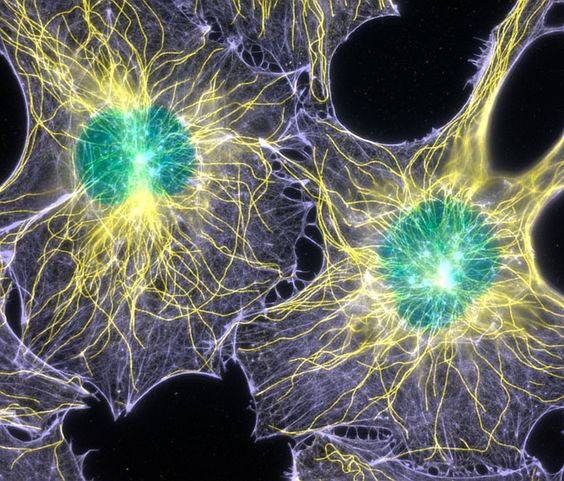
Neurons, Photo by Heiti Paves

Two neurons communicating.  Photo by Heiti Paves.

Current estimates are that we can handle about 2 ½ petrabytes of information.  A petrabyte is a thousand terabyates.  A terabyte is a million million bytes.  We are walking around with bodies that can process some 100 trillion data points each second.  Not bad for an animal like a human being.  But then, we were made in God’s image.

You’d think that would be enough to get a lot done.  Theoretically anyway.  But NOPE, that’s not enough.  We need both the power tools and the information about how to use them wisely.  We can all attest of periods of feeling completely overwhelmed by all there is to handle in the world, particularly when we are in sensation-rich environments, around a lot of technology or a lot of people to intensify the data stream assaulting our senses.  Right now we are densely packed in a world of over 7 billion people, immersed at every moment of the day by technology beyond our wildest dreams, with most of us so stressed that even the brightest of us can barely handle the basics.

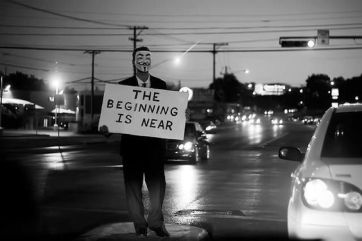
When we don’t know how to handle life’s challenges, we tend to use people and organizations as shortcuts in processing information. This is where it gets tricky.  We give other people the power to determine what we feel or believe about the world.   Many have long since figured out that the best way to control other people is to get them to fear things they do not understand.  As our world becomes increasingly complex using our current inadequate cognitive skill set, it is relatively easy for power mongers to generate fear in people; and also alarmingly easy to confuse people.   Elections in the United States are now routinely “bought” by corporations and wealthy individuals with the thousands or millions of dollars it takes to spread the viewpoint they want citizens to hold.  We are going to need a new cognitive skill set to make it through the next months.  Thus the looming paradigm shift.Beginning is Near
Luckily the problems that we face are not exactly new, just greatly intensified, so we do have some history upon which we can draw.  For centuries humans have been living in the world that overwhelms us with its vast amount of sensory data.  We have dealt with our fear and confusion by giving up our power, giving our decision-making to other humans that come along and tell us that THEY know the right answers.  Usually it’s religious or political figures that tell us that we should believe THEIR version of the truth.

Every once in awhile, a Buddha will come along that will remind us that everything we need to know is within us, if we just wake from our state of sleeping through life.  Every once in awhile a Jesus of Nazareth teaches us to seek God within us, to desire to know its Truth and to listen to it when we find it.
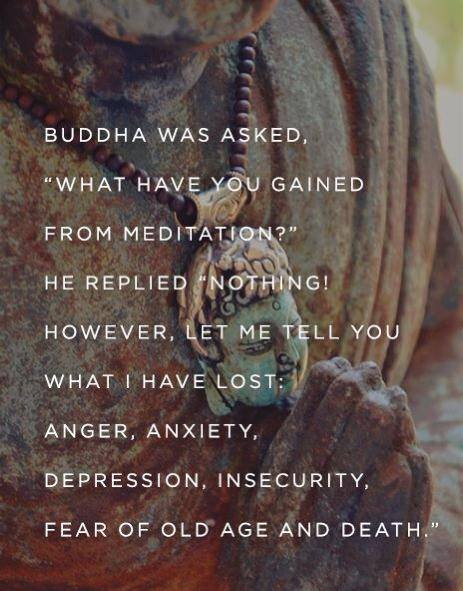
Meditation According to the Buddha

The Buddha lived circa 500 to 400 BCE.

From its start the universe has been conspiring to help us recognize the Truth whenever we are open to it.  Key individuals have challenged the cognitive stronghold promulgated by the religious dogma that is usually a big factor in keeping the Truth at bay.  In the sixth century the man we know as the Buddha took the first major chunk out of the entrenched Hindu caste system on the Indian subcontinent.  Many centuries later Mahatma Gandhi would convince the British Empire to move out of India and the caste system would be officially eliminated.  But way before that it was the Buddha who set the stage of teaching hundreds of people to begin the search for themselves.  He told ordinary folks, not only the “untouchables” but anyone below the highest caste, that they did not need the Brahman, the ruling priests to intervene for them in the ways of the universe.  He taught them how to turn within, to meditate to find those ways for themselves.

Around the same time, another search for the truth was happening in China.  Confucius revolutionized thinking in the entire Eastern part of the globe by bringing a greater sense of individual truth-seeking to how humans should process information.   He was one of the first major proponents of the “Golden Rule.”  He talked about the important of treating other people well by following one’s own instincts.  He maintained that if society fails it is because sacred texts and teachings have been misinterpreted.  He told his students that the texts contain the “Way,” but individuals must search for and find it themselves.  He helped shift  human consciousness of much of the civilized world that was China towards pursuit of the Truth.
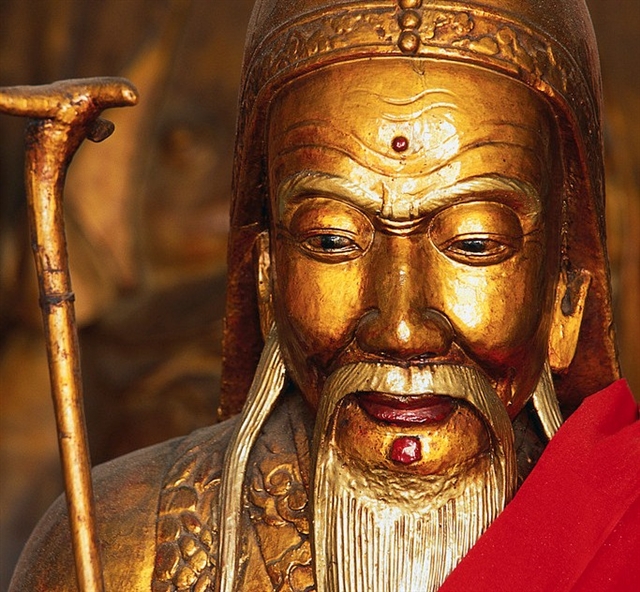
Confucius lived from 551 to 479 BCE.

And then, of course we have the Christ, who preached that individuals must first and foremost find their answers within, by finding God’s kingdom within each of us.  His teachings have been misunderstood and subverted over the years but periodically, the universe pulls us back closer to the possibility of discovering Truth as Jesus defined it.
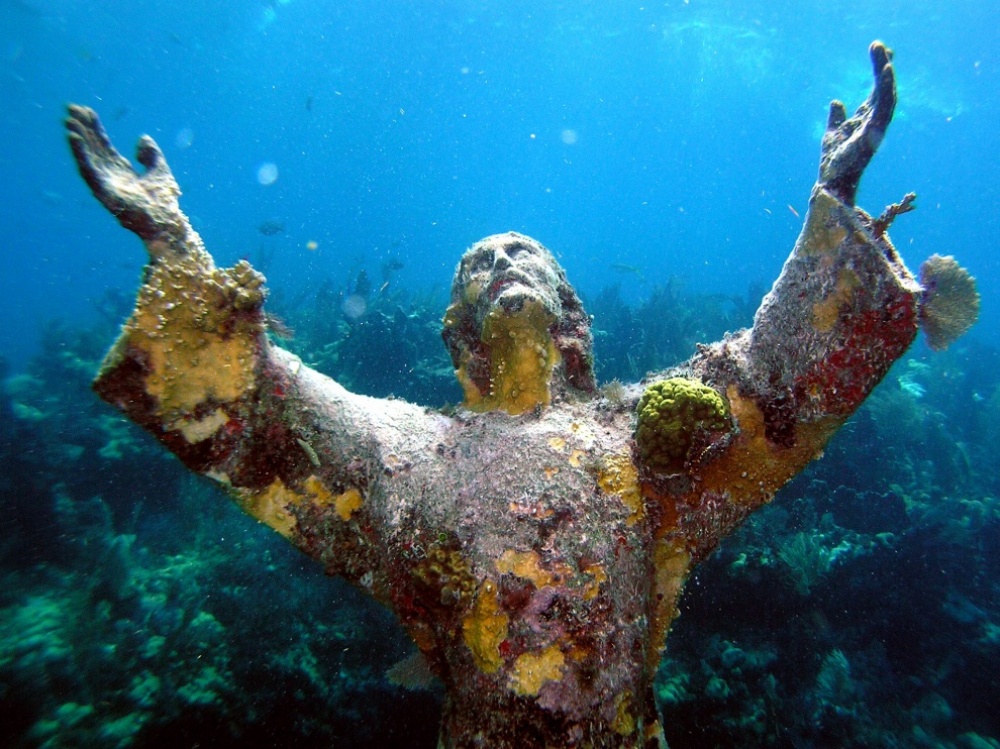
Christ Underwater, Key Largo, Photo by Lawrence Cruciana

One such point was the Protestant Reformation around the end of the 15th century early part of the 16th century, when an obscure German pastor named Martin Luther and various of his colleagues reshaped life in Europe and beyond by challenging the Roman Catholic hierarchy.
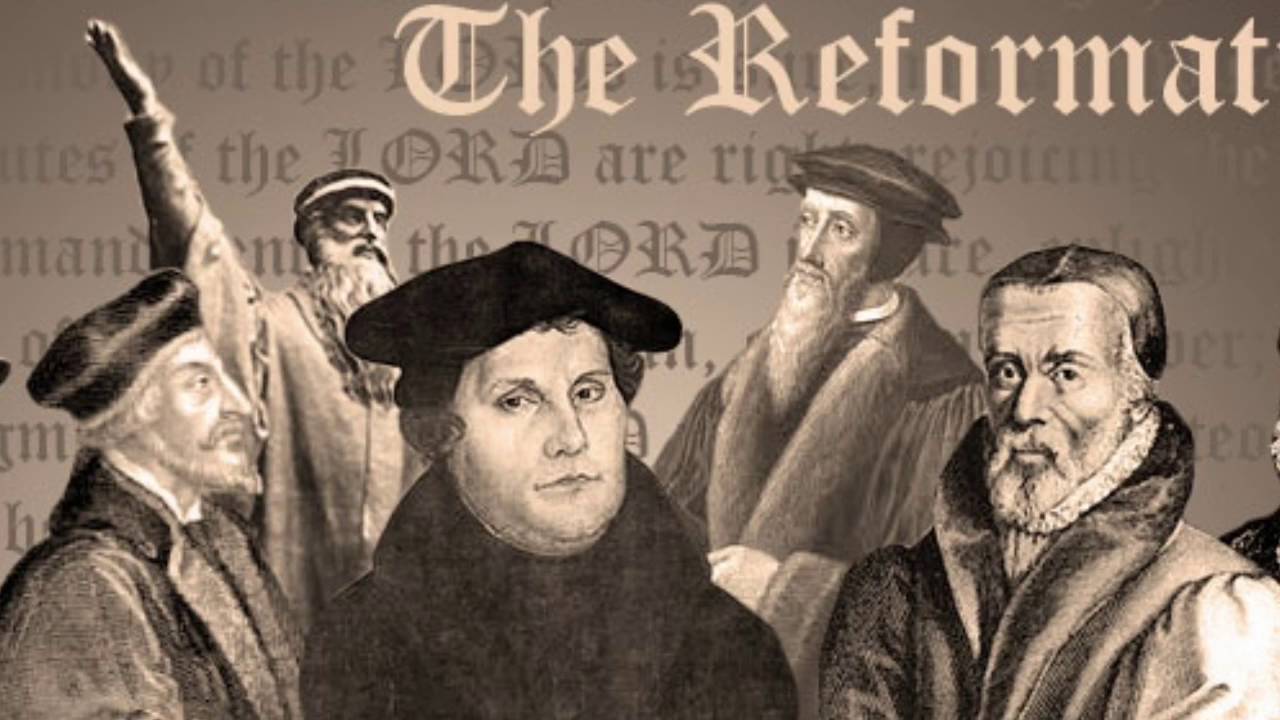
The statement Martin Luther hand wrote and nailed to a church at Wittenburg in 1517 eventually was reproduced by the new printing presses some 250,000 times, the first such incidence of mass circulation of the written word. His stance spread throughout Europe and led to a movement by religious leaders of many countries to develop their own version of Christianity.

The Reformation is sometimes seen as just political infighting among rival Christian sects, but really it was bigger than just a religious war.  At its essence it was also an  epistemological cultural war, made more vicious by the advent of new technology, very much like what we are going through today.  At issue was who gets to decide what is true and what is not; and how the Truth should be sought.

At the time, Catholicism had become the supreme authority on both spiritual and secular life in Europe.  Typically only monks could read and write books and only monks and priests could speak Latin.  This was important because Latin was the language of the Bible which was the sole basis for the moral code for society.  Therefore, any person in Western society who wanted to live such that they would enjoy success in the outer world; as well as prepare for what they believed was going to happen in the after-world, had to rely on a priest to tell them what to think and feel and how to live.

It was no coincidence that Luther nailed his objections to the way the Catholic Church was doing business in the same time period that Gutenberg was perfecting the oil-based inks, non-parchment papers that could be produced by new water-powered mills, and early printing press machinery that allowed everyday people outside of the church structure to obtain reading materials.  Gutenberg BibleHumans were ready for the triumph of literacy.  And when we were ready for the gift of greater proximity to Truth, on a physical level the resources appeared to allow for dissemination of knowledge through the written word; and on a spiritual level the information we were getting from our religious institutions made a major shift.

The digital period in human history which started in the last few years is another such evolutionary step in human consciousness.  We are right on the precipice.  We have been so since the 70s when computers reached into our collective lives.  We are obsessed with redefining Truth because we are right on the verge of developing the next huge leap in being able to recognize it.  We don’t even know what that truth is going to look like yet.


To get through the next period enough of us human animals have to choose a truer pathway that is savvy about both energy and information.   Here are a few clues about how to work with the unlimited amount of energy available to spirit within the context of a very limited physical form, as the world around us goes through an earthquake-like paradigm shift of unimaginable proportion.

Find your own truth.  This is actually a little more complicated than most people think.  It’s not about what feels right.  That can just be a result of unresolved emotions.  It’s not even necessarily about what you think is right.  That can just be old programming, ways you’ve been taught to think that are unexamined and not really consistent with whom you really are.  Finding your own truth requires you to look within yourself, and do so with enough regularity and courage that you learn to distinguish your own voice from that of your mother and your father and your siblings and your friends, your kids, your social models, your teachers and  leaders and your country; and even from the parts of you that you have outgrown such as your inner child and your experiences in other lives.

SPOILER ALERT:  Meditation greatly facilitates this process.
Listen

Obviously, for all of us finding our truth is a lifelong process.  But it’s one that you have to choose.  Truth won’t seek you out.  Look around you at the world.  Look at all the people that are choosing to stay ignorant of the truth, thinking that will somehow protect them or make it easier for them.

Animals sometimes think that they are safe when they cannot see others. Human animals no longer have that luxury.

It won’t.  Not anymore.  It could be argued that ignorance might have served human beings in the past.  But no longer.  There is no place on Earth anymore where you can hide from knowledge.  All you can do, is distort it.  And if you want to be one in alignment with the Truth, you have to actively look for it, no matter what the cost.  Seek and you shall find; knock and the door shall open.

Second of all, in your search for your own truth avail yourself of the truly miraculous amount of help available to all seekers after the Truth, just for the askingIn the digital age nearly all of human knowledge is readily accessible, sitting quietly waiting for you to discover it, as close as the nearest smart phone or home computer.   And not only is the data ever present, the ways to work with it are as well, at least in this part of the world.

If you want to use the scientific method to explore the truth contained in the natural world, you no longer have to give up everything you know, find some obscure castle where you can work in secret and isolation and hope the inquisition doesn’t find you and burn you at the stake.  You just have to decide what you want to explore, and enroll in the nearest community college with a program in the subject matter of your choice. You can establish your own community of scholars to help sharpen your critical thinking skills or ability to take into consideration the viewpoint of other cultures.  You can sign up for a conference calling and talk to anyone around the globe that will talk to you. Sun Supporting Diversity If you want to find truth through the more invisible world of faith, you don’t have to accept the viewpoint of just anyone who offers their perspective through a church or new age type class.  You can readily find information on how to discern between legitimate truth-seeking and proselytizing or programming and follow the person and process that brings you closest to the divine.  You learn how to access your own God-given talent for the Truth rather than give up power to others.  And that’s just on the physical side of things.
Energetically, all true seekers after the Truth automatically receive the assistance of the entire spirit world.  Insights come not from emotion but through seemingly random ah-ah moments and from the dream world.  “Coincidences” hit you over and over until you pay attention to the pattern within which you are exploring.  Teachers appear when you need that kind of assistance.  Your ego will even trip and take a fall for you when it is too much in your way.   Keep your eye on the prize, the richness of the Truth; and it will find you.

Third of all, don’t worry about other people’s versions of the truth unless it is actively interfering with your own.  Let people be as deluded as they want to be, unless they are the makers of public policy.  Even then you don’t need to call them liar even when they are.  Incorporated into the physical, we are all living a lie.  If you are fortunate enough to be living a version closer to the Truth, rejoice and fill yourself with gratitude.
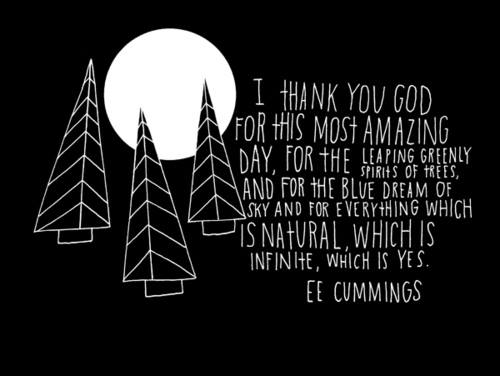
Thank you God

You do not necessarily need to try and change the mind of those who are choosing the company of ignorance.  Unless they are open-minded, that can be a waste of your precious time.  You have better things to do. . .like finding yourself.
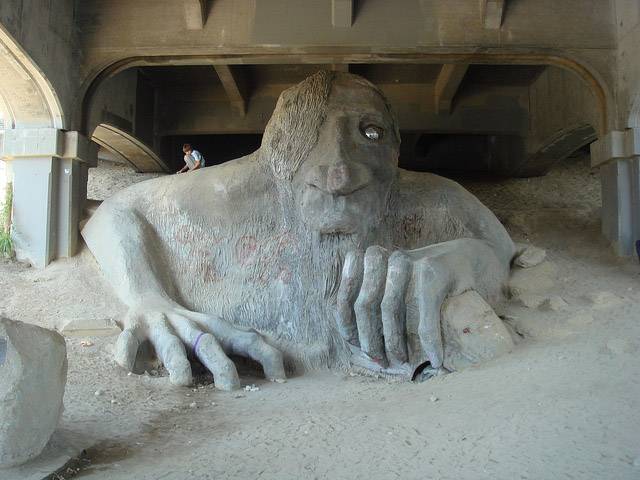
Freemont Troll

Trolls are generally a waste of cognitive resources. . .unless you find it a fun way to spend your time. This one is the famous Freemont Troll under a bridge in Seattle.

There are enough people who rejoice in the Truth that will can use your assistance in accessing whatever corner of it you have figured out.  You just need to prevent the willingly-ignorant from harming others to whatever extent you can.

Tuck into a corner of your mind the words of the Christ from Matthew, Chapter 7, Verse 4:

How can you say to your brother:  Let me take the splinter from your eye

and behold there is a beam in your own eye?                         

Like it or not, those who intentionally deceive others for their own economic or political gain, as appears to be the case for many or most of the U.S. Congress and the White House right now, actually deserve our compassion.  They are creating their own hell and are truly losing their soul, one step at a time.

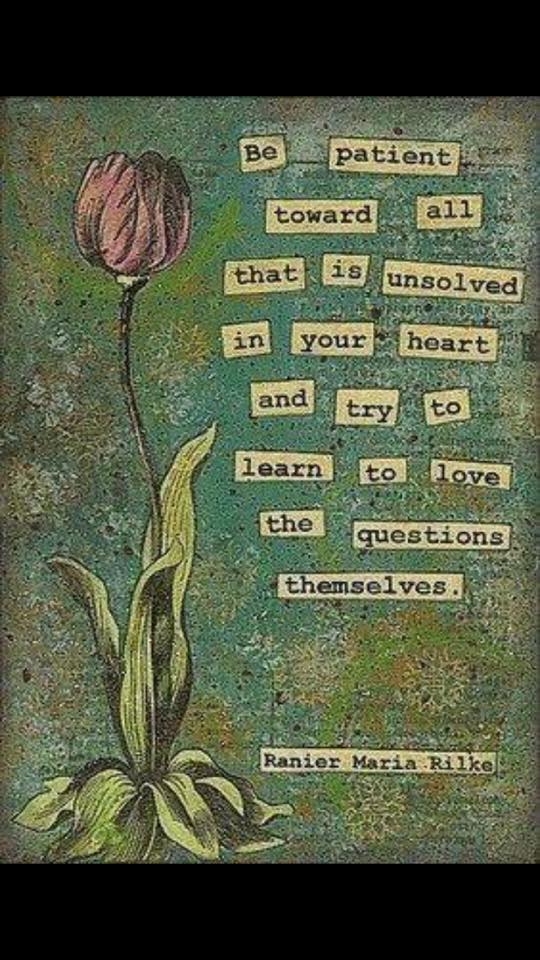
Last but most important, defer always to the greater Truth.  Cultivate humility.  It is your friend. Love the Questions That includes getting comfortable being confused at times and freely acknowledging when you do not understand something, or when you have been wrong about something in the past.   As my atheist mother used to say, the truly wise know how ignorant they really are.
As her spiritually-minded daughter, my own version of the truth is this:   We will never completely know the mind of the Goddess until we are once again fully reunited with her.  But in the meantime, much is given to us when we seek her counsel with all of our heart.

Copyright 2017 by the Rev. Dr. Resa Eileen Raven

The Wintering of America

From a Sermon given Winter Solstice Worship Service 2016

Winter Solstice is the time we traditionally get together to celebrate the transition that begins at the end of the year and moves us into the beginning of the new year.  Winter is such an underappreciated season, maybe because it forces us to slow down, nudges us into reflection, sets us on the path of integration and changes to come.  It’s like Nature’s growth period, not in the biological sense of things growing, but in the spiritual sense of destroying old cycles with which we have been living; making room for new cycles that are not yet apparent.  It is a time of bareness, of winnowing the exterior world down to basic necessities, so we can look around at a blank canvas and dream about what we want to create.

This year we have the opportunity to do this reinvention not only in our individual lives, but in our collective lives.  I know of many people in America and around the world who are reeling from the shock of the election of Donald Trump to the Presidency of the United States.  They say that even most of Trump’s followers were in shock that he actually got elected.  To all who are confused, in anger or fear, or otherwise distressed, I dedicate these words.  This sermon is not about politics.  It is about life on Planet Earth and moving forward when we find ourselves in deep and unfamiliar winter territory.  uncertainty

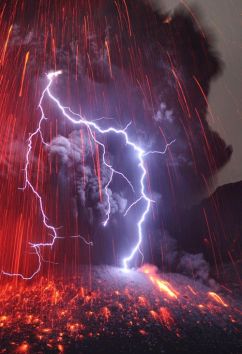
When I woke up the day after the Election to find we now had a President-Elect Trump, I had many thoughts and feelings, many of which were unpleasant to experience to say the least.  But in the deepest part of me I found a small but very bright and very profound ribbon of gratitude.  I knew exactly what it was about.  I knew in my heart that Donald Trump was not “destined” to be President as of the day before the election.  There are very few times that I know something beyond a “shadow of a doubt.”  But I believe without a shadow of a doubt that the mockup a scant day before the election was that Clinton be elected.  We can blame the media and the pollsters all we want for not preparing us better.  There is certainly no end to the “soul-searching” that the media needs to do about their choices during the election, but they are not to blame for projecting defeat of Trump.   On a spiritual level we had decided that Clinton was going to be the “winner” oflightening-and-lava the election.

And then we changed our collective mind.

The day before, no less.

I mention this almost in passing because perhaps it will bring some solace to individuals who are still lost in the maze of the election energy.  But mainly I mention this because miracles need to be acknowledged, especially ones that are invisible to most people.

It is nothing less than a miracle that an entire nation changed its mind within 24 hours about who to let become President.  The ramifications of this energetic shift are enormous.


What it said to me is that there is hope.hope-changes-everythingYou all know that my primary focus and concern these days is on the very real possibility that human beings will not survive on Planet Earth.  In order to “weather” (pun intended) the changes we are bringing to Mother Earth in our arrogance we must make some rapid behavioral shifts in our thinking and behaving.  Further, these changes require a change in human awareness that in my darkest hours has seemed light years away.



If you have any idea of how the consensus reality works, you will recognize that apparently, enough of us have made and/or are making those changes in awareness that a massive shift in the time-space continuum is now possible.  Nothing else explains the fact that one day Trump was not slated to be President and the next day he was.  The fact that collectively so many of us can manifest an energetic shift of that magnitude in that short of a time frame means that we stand a fighting chance of surviving climate change.  And for that, my heart sings with deep gratitude to God and to all of us who are trying to learn to genuinely live consistent with its will.  This was so much bigger and more important than who occupies the Oval Office (or the Trump Tower as it may be).

Here at the Church of the Harvest we have been talking for several years about the fact that humans have constructed a world on the basis of scarcity and conditional love; and in order to move to a world based on God’s endless bounty of unconditional love many of our social, economic, religious, political, and other institutions will need to be destroyed with some being rebuilt in a far different form.  What we just did in our electoral process is greatly accelerate the timeline in terms of destruction.  I was hoping we would not have to do the destruction phase overnight because I know all too well what a hard time people have with change.  The American people decided otherwise.

Is it a good thing or a bad thing that all that we upped the stakes in terms of destruction of our world?  It remains to be seen.  We know that from a spiritual perspective there is no good or bad, just experience.

mayan-dancer-representing-an-owl-symbol-of-death-in-mayan-mythology

Death=Rebirth=Potential Wisdom. Mayan Dancer Representing an Owl, Symbol of Death in Mayan Mythology

We also know that our human brains cannot comprehend the master patterning of our Creator.  History has repeatedly revealed points in which horrible things have happened to individuals and to the world within which they live, in order that even more horrible trends are stopped in their tracks.   Think Pearl Harbor for example, where over 2,400 individual souls made the decision on a spiritual level to sacrifice their life, and another 1,000+ were injured so that the U.S. could wake up to what was happening in Nazi Germany and make a decision to enter the World War 2.

pearl-harbor

The attack on Pearl Harbor, December 7, 1941

If Pearl Harbor had not happened, it is very likely that not only all of Europe and Asia but probably our continent as well would be under occupation by National Socialism.   The destruction acceleration we just made possible in the United States can bring those who withstand it closer to each other and to Nature and therefore, to the ultimate preservation of human life.

I have been tracking the destructive trends for many years now, but the aspect of those trends that I feel drawn to discussing this morning is the perfect pictures we all have about the United States.   Most of you have heard me say that the road to Hell is paved with perfect pictures.  Perfect pictures are those insidious little bits of programming on an energy level with which all old spirits struggle, that tell us that things are supposed to be or go a certain way.   being-wrong

They create a great deal of grief in part because the world doesn’t oblige us by conforming to our pictures so we lose our way more readily.  Additionally, they generate a ton of blame, hostility, and intense fear when the world doesn’t live up to said pictures, which actively interferes with the learning that needs to happen to get closer to the ideal.  Blame and hostility:  Thinking about this election, does this sound familiar?

The United States is a place rife with perfect pictures, almost like an orchard of overripe fruit that falls from the tree and makes such a big mess that it’s hard to even walk around without falling.  The idea that this country is a new and better version of any other country on the Planet has been part of our national credo for over two centuries.  “We the People,” our “creation myth” to use a label from anthropology, did indeed reflect a giant step forward in the evolution of humanity.  Our fledgling democracy was a great achievement but contrary to the popular belief it was never a perfect one.  The “New World” as we called it, afforded some of us a chance to move beyond our history, but not all of us.

Initially the constitution of the newly formed United States primarily protected the rights of wealthy white men.  Right off the top, over half of the population could not actively participate by virtue of their sex–women.  And then there were the Africans who were not yet called “African Americans” and who were not even acknowledged as human but rather, were each designated as 3/5s of a person for the purpose of property taxes.  The over 12 million Africans who were forced into slavery by the 1900s primarily for the economic benefit of white people were missing from our national narrative of greatness. Also by the 1900s  immigrants primarily of European ancestry had  destroyed 80-98% of the indigenous Native American population through displacement, war, other forms of violence, a fact that we happily justified by the 19th century doctrine of Manifest Destiny.   In the United States, we have tried very hard to not notice that American dream was very hard on many; and that everybody in our country did not exactly have the same degree of a chance at reaping it’s rewards.

Nonetheless, the idea of America as the land of opportunity for all has been important to the entire world, not just those in the United States.  For both spirit and body, dreaming is VITAL and America has provided a life-affirming destination for everyone.  With our shiny idea of a place for all, the U.S. has provided hope for hundreds of years to people all over the Planet, allowing thousands with torturous lives to believe in something outside the drudgery of their existence. As a political institution, the U.S. may not have always lived up for our ideals, but that does not make our support of them any less important.  Perfect pictures are often created for noble reasons.  Eventually they always crash under their own weight unless one actually walks the walk, as well as talks the talk.

Lest you think that we worked out all our earlier quirks with constitutional amendments and changes to the law, no.  Yes, women got the vote, almost 150 years late but we did get to participate.  Indentured servants and slaves were eventually set free.  But as to the national culture, we never really worked through our perfect pictures, our ego-based sense of importance.  Even the fact that we made some laws more just for segments of our population became just more evidence in our collective mind of our moral superiority.  We just kept adding to the narrative, calling ourselves the most powerful, richest, smartest and therefore, by implication the most deserving country on Earth.

We began to believe that the United States was uniquely qualified to lead the world in every respect, not just some areas.   We carefully tried not to notice that the ways in which we were exercising our leadership was typically disrespectful of other cultures, sometimes aggressive and/or exploitative, and frequently self-serving.  In the United States the lifestyle of not only the rich-and-famous but even the working-class-families-who-routinely-shop-at-Wal-Mart, has greatly benefited from our commitment to American superiority.  In the lifetime of those in this room, United States citizens who are 20% of the world’s population at best have been owning, controlling, and in most cases using 80% of the world’s resources.  We made it to the top of the heap.  But at a price to our soul.

What has this got to do with the elections?   The recent U.S. presidential election was essentially a cultural war between perfect pictures.  That’s a war nobody can win.

change

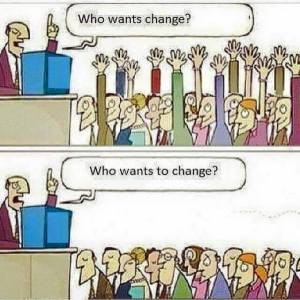
Obviously, we all have a sense that change is needed.  We just don’t agree on what the problem is or how to go about fixing it.

Trump got a lot of voter support because of his carefully chosen motto:  “Make America Great Again.”  Some folks recognized the cultural arrogance of such a motto; and proposed their own slogans.  I enjoyed the various wordplay in such mottos as “Make America Smart Again,” “Make America Mexico Again,”and my favorite “Make America Kind Again.”  But the reality is that as a whole, America has never been smart, kind, or great.  Not consistently; and not as a whole.  Individuals and small groups of Americans have at times done truly great things, chosen innovative, courageous and selfless words and deeds.

c495d8bc8cbff92155a422231c852bbf

The Navajo code talkers were critical in helping the United States defeat the evil of WW2 Nazi Germany and Japanese imperialism. Twenty nine of these dedicated Marines were awarded the Congressional Gold Medal. There are an additional 33 other tribes that have been code talkers using their incredible communication skills at other times when the United States has needed them, acts of generosity and true patriotism given what Native Americans have endured from white society.

As a nation we have often been generous and insightful, but intermittently.

Clinton’s “Stronger Together” motto was much less embraced, not only because of people’s reactions to Clinton but because it is a weaker archetype that did not spark the nation’s imagination.  We don’t need to be stronger, exactly.  We need to be strong in a different way.  We also don’t need a false sense of togetherness.  We need the real thing.

The social fabric that is the United States of America is vast, multilayered, contradictory and imperfect.  We need to acknowledge that, stop trying to insist we have already got it right, and realize how much we have to learn.  We need to atone for our sins/trespasses to date, move with more honesty and whole lot more humility towards the ideals to which we aspire.

perfection-words-by-anna-quindlen

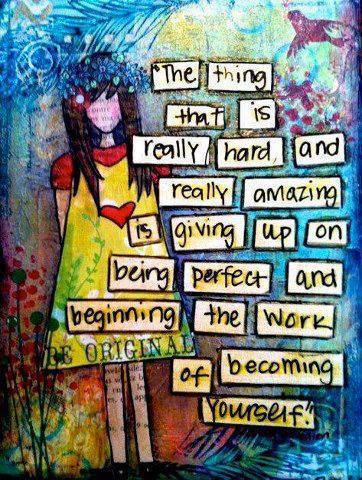
Perfection. Words by Anna Quindlen

The universe just gave us a hand.  It just knocked us flat on our collective ass so that we could go back to the drawing board. No more building houses on foundations of sand.  We have to change the way we think.  As a society, we have to create a new narrative based on Truth.   In this story line I imagine us still pledging ourselves to the justice of democracy for all, while acknowledging that we don’t always achieve our goals.  We have to grow beyond our tribal thinking.  We have to learn to think from a spiritual perspective, one that respects the basic unity of all life and the moral superiority of no one.

That said, the landscape before us at this point is looking pretty dark. At this point when we are all swimming in the ocean of confusion, getting back to the basics may be warranted.  So I have three things to say today about negotiating the Wintering of America.

First and foremost:  Do what you came here to do.  You choose this time.  On a spiritual level you made the decision to bring yourself back to Planet Earth during this time period which may be the most fascinating and crucial years in human civilization, apart perhaps from those brief 30+ years that Jesus of Nazareth walked on Earth.  You are here now for a reason.  Find your path.  Let your light shine brightly in these dark days.  The rest of us need that; and you need that.  Don’t let the chaos, anxiety and confusion of the world stop you from finding yourself.  It’s more important now than ever.  Your interests are of paramount importance to us all.  It’s still all about individual responsibility in a time when thousands of people are wanting to dictate what direction you should take.  Find your own Truth.  The God of your heart will tell you where to go, what to do, and what to be, if you just take the time to listen.

Second and also very important.  Do what you can with other people.  If you are a part of the Church of the Harvest, you are a big giver.  Most of you work with the public through your jobs in social agencies, government, private industry and the like.  You are all highly social people, committed to family and country, generous to a fault.  You already know what you can do FOR other people.  All of you are skilled at that.  Now figure out what you can do WITH other people.

Little known fact is that from a spiritual perspective, human beings are really at the very beginning stages of learning to work collectively in a genuine fashion.  We have not gotten much beyond survival mode.  We have learned to hunt together, necessary to bring down large mammals. We know how to band together to fight wars against other humans not a part of our immediate community whether it’s “playing politics” at a local level or waging conflicts and wars on a massive scale.  Humans have been very good at uniting AGAINST things.  As a species, we are still in elementary school when it comes to genuinely uniting FOR things.

inclusion

This is the time where the world must learn what it really means to be united in spirit while at the same time allowing for, even honoring and celebrating individual differences.  It’s about transcending the dichotomy, living the Truth, understanding that on a soul level you ARE the other; and they ARE you; and we ALL ARE aspects of the same God. . .at the same time that each of us is an individual soul with an individual mandate to follow the dictates of the indwelling God of our individual hearts.

You have a head start with this vital learning; and you can model for others.  If you are part of the Church of the Harvest, through your meditations you are committed to a process of manifesting the unity of spirit within a unique body. Figure out where you want to be giving and helping others and go for it, while never losing sight of your own path.  Work together with others whenever you can do so without undermining your own integrity.  Do what you can think to do but know that you can’t do it all because not everything will be on your path.  Support people who have found a different vantage point for their gifts, as best you can.  Speak up and lead righteously in the areas which have been given to you; and be a great witness, listener and supporter in the areas where others are on the forefront.

The model we all have for transcending the dichotomy of the individual soul living within the unity of all was given to us 2000 years ago by the Master.

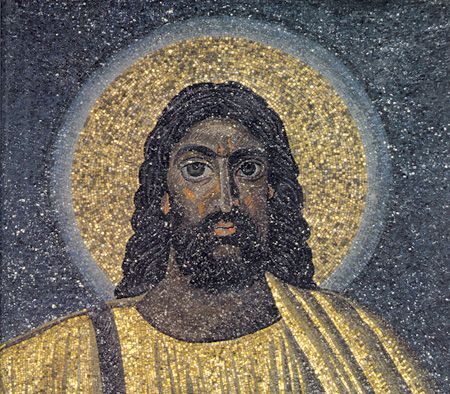
mosiac-of-jesus-in-a-church-in-rome-ad530

Mosaic of Jesus from a Church in Rome 530 ACE

Listen to the words of the Christ as he discusses the idea of the individual soul living as a part of all-that-is.  This is from Matthew, Chapter 23, and Verses 36-39.  Remember that when he talks about God he is talking about the Kingdom of God within each of us–not some old white dude in the sky.

Teacher, which is the greatest commandment in the law?

            Jesus said to him:  Love the Lord your God with all your heart

            And all your soul, and with all your might and with all of your mind.

            This is the greatest and the first commandment.


            And the second is like to it,

            Love your neighbor as yourself.


My third piece of advice is this:  Don’t be afraid of the wintertime.  We know that from a spiritual perspective there is no bad and good.  But we all have a tendency to fall prey to the perspective that winter is the not-so-good or even bad season.  Nature knows better.  All plant and animal life needs an extended period of rest.  In the Pacific Northwest we know that the very waters that sustain our life come predominantly from the snow that falls in the winter to recharge the aquifers.  Recognize the richness of the wintertime of dreaming up new futures, reflection and prayer.

Yes, some of Nature always dies in the winter, adding its carbon and other minerals back to the Earth so that other species will have room.   And with great regret I will confirm what you all know, a greater amount of life on Earth will be dying during this Winter than ever before, both human animals and nonhuman animals so that we all have a greater chance to find eternal life.  But from the big picture, from the mind of our Creator, it’s all good.  We need to hold that Truth in mind.

Again, words of the Master, from Matthew Chapter 24, Verses 10-13, in which he speaks about the “end times” that we are now experiencing:

Then many will stumble, and they will hate one another and betray

                    one another

And many false prophets will rise and will mislead a great many.

And because of the growth of iniquity the love of many will become cold.

But he who has patience to the end will be saved.

fireplace

Hunker on down.  It’s going to be a long winter.  Let’s keep each other warm.

Copyright 2016 by the Rev. Dr. Resa Eileen Raven

The War Between the Sexes

From a Sermon given Winter Solstice Worship Service 2002

All this year, as a Church we have chosen to focus the healing energy of these services on the issue of peace.  We have talked in various ways about war and peace in the world at large as a reflection of war and peace in our individual lives.  In today’s sermon, I would like to talk about what is for many of us the greatest war that we experience in our lives, even though it is sometimes so huge for us, so all-encompassing, that we forget we are in the middle of it.

Unless you are a member of the military, or some other war-related industry or profession, you are probably not exposed to the ravages of physical combat.  But there is one war that is ongoing, one war that is waged in all nations and all cultures, and among all races on the face of the earth on a daily basis, one war that can be funny at times, approached by some people in good humor and can also be horrific and hard to laugh about, and everything in-between–and that is the war between the sexes.

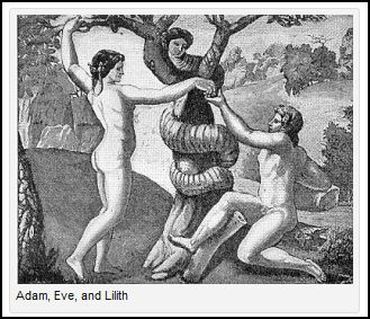
The war between the sexes has been around as long as human beings have been on the planet.   I would say that it began with Adam and Eve, except that according to some religious traditions, there was a woman named Lilith, who proceeded Eve, but got in trouble with Adam and/or God the Father, because she was not acting in the approved feminine way.  So we might say that the gender wars even predated the couple that are considered by many to be the ancestors of us all.  In any case, as long as spirit has been incorporated into physical matter on Planet Earth, there have been problems and dissension among the ranks in regards to the gender differences between bodies.

Adan, even and Lilith

Adan, Eve and Lilith

On a physical level, there is not much difference between genders, certainly not enough to justify the controversy.  These days, in this country at least, we mostly acknowledge at least some of the time that almost everything about the human experience is universal in nature, including our physicality.  It is said that there are only two activities in the world that are gender-specific.  Only men can contribute sperm.  And only women can bear children.    Apart from these activities, everything we feel, everything we think, every choice we make, can be felt or thought or chosen by the individual involved, whether they happen to be male or female.

On an energy level, there is one very small but far-reaching difference between genders, and that is the placement of the first chakra.  The first chakra is that powerful energy center that contains much of our information about physicality.  The majority of everything about how we relate to our individual bodies as well as the body that we call the Planet Earth, is connected to or is stored in the first chakra.

In men, this chakra is physically much closer to the Planet, and is greatly affected by gravity and the other forces associated with the Planet.  When we talk about men having heavier energy and women having lighter energy, when we talk about men being more caught up with the earth, and women being more focused on the heavens, when we say that Men are from Mars and women from Venus, when we notice that men are more interested in self or creating a separate space, and women more interested in others or creating relationship connections, all we are doing is noticing the differences in perspective that come depending on where the first chakra is located.  If the first chakra were in the same place in both male and female bodies, these differences in perspective would not exist.

So why, do you ask, is there is difference in the placement of the first chakra?  What is the purpose to this, in the larger scheme of things?  The reason for the difference in placement of this spiritual center, as well as the reason for the differences in gender of the human body is the same:  it’s all about creativity.  It’s all about creativity.

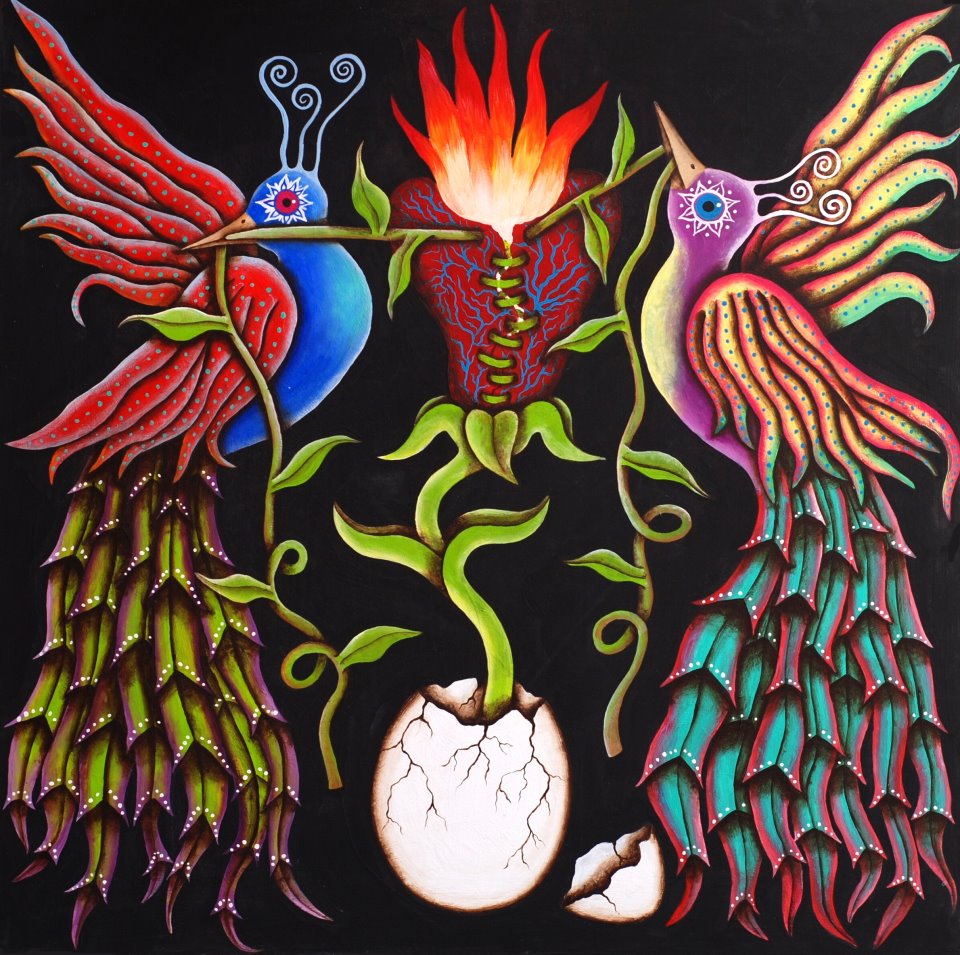
It Takes Two to Lay an Egg by Jade Lavey

It Takes Two to Lay an Egg by Jade Lavey

We are spirit, and as spirit, we are a part, an aspect of the Creative Force of the Universe.  There is a reason why God is often referred to as the Creator.  The existence that is sometimes labeled “God” is pure, unadulterated, conscious Creativity.  And we are here on this planet of substance and mass, to learn to be the children of God, to learn how to create through physical matter.

Creativity at its most basic, can be broken down into dual energies that in eastern traditions are called “yin,” and “yang.”  In our part of the world these energies are sometimes called “the male principal” or “male energy” and “the female principal” or “female energy.”  These are the basic building blocks of all creation.  This is the ebb and flow of life as it manifests itself.  When male energy, the active part of the cycle of life, unites with female energy, the receptive part of the cycle of life, creativity is born.

On the physical level, when a male body unites with a female body, a new life is possible.  We all know this.  What we tend to forget, unless we have formed the habit of looking beyond the physical, is that each of us is male and female energy.  Since everything in the physical ultimately arises from the spiritual, each one of us is composed of male and female energy, regardless of the gender of our body.  And everything about our lives is an interchange, a dialogue of sorts, between these two forces in ourselves.  That dialogue can be a harmonious chorus, a spirited debate, a silent standoff, an outright screaming match, whatever but it is always an interchange of some kind.

On the energy level, when the male part of any individual’s energy system unites with the female part of that individual’s energy system, creativity is possible.  When an artist produces an object of beauty or a musician plays an enjoyable melody, they are using their male and female energy in concert, to create the object or experience that is pleasant to see or hear.  When a miner extracts coal from the earth or a baker makes loaves of bread or a doctor takes care of injured persons, they are using their male and female energies to create a synergy within them that allows healing to happen outside of them.  At every point, we create our individual lives, and we use our male and female energy to do so.  And at every point, we choose whether these parts of us will work together, complement each other, support each other; or whether our male and female energies will be at war.

Unfortunately, one can tell from the state of the world at large, what we call around here the consensus reality, that there are a lot of us making choices that have us at war with ourselves.  Everywhere around us are individual men who are brutalizing the women in their lives in order to try to get themselves to notice that they have brutalized their own female energy.  And everywhere around us there are individual women who psychically, psychologically and emotionally manipulate and/or dominate the men in their lives because they cannot allow their own male energy to act on their behalf, and therefore, attempt to force others to act for them.

To complicate the equation, we have created whole societies in which those in female bodies this time around spend their time engaged in power struggles with those in male bodies, and vice versa, just because we are unwilling or unable to ground and work through our own space.  When we need the other gender to complete what is missing in us, then we create dependency, as well as resentment of the object of our dependency.  So then we have centuries of experiences on Planet Earth of relationships between men and women that are based on scarcity or lack, and are compounded by bitterness and blame of the other gender for that lack.

The good news, folks, is that the times, they are truly changing.  It is the time when the male and female is scheduled to come together.  Everywhere around us we are seeing the mirror images of the vast changes that are being made in human consciousness.  We have female astronauts, welders, and body builders, and male nurses, nannies, and househusbands.  We have whole societies who are making major shifts of consciousness, virtually overnight.

One such that occurred recently with little media attention, happened in Afghanistan when the women of the country decided to oust the patriarchal Taliban leadership, and quietly convinced their Afghanistani husbands to take this action with evident success.  The United States might like to take the credit for the radical transformation of the political structure there, but the real success story is about those spiritual beings in both male and female bodies who live in the area who were determined to move the next step for them towards a greater honoring of the feminine.  Granted, there will likely be a kick-back of sorts.  Humans typically resist change.  We can expect that the patriarchs of Afghanistani culture will not give up without many, many more battles, but the game of change is on.

Afghanistani Women Outside Polling Place, 2014

Afghanistani Women Outside Polling Place, 2014

And now, in this country, we are coming up to the end of the cycle that has lasted almost 3,000 years, as we shift from a rationally-driven male-energy-based technological society, to one in which intuitively-based female-energy leads the way.  In this brand new cycle, the male and female energy in each of us will be honored but the female principle in both men and women is moving into the leadership position of our individual and collective soul.  Throughout history, certain forward-thinking individuals all over the world have made this necessary shift, but I predict that the United States may very well be the first society that will embrace the balancing of male and female, under the leadership of the female.

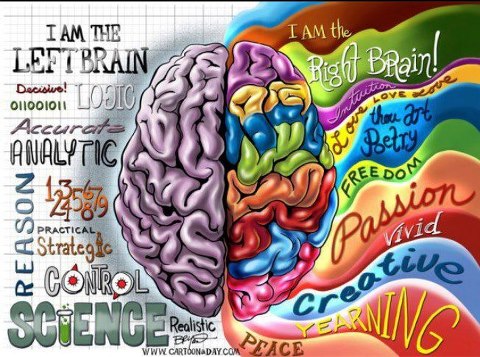
Left Brain Right Brain

Even our very body/brain reflects the feminine and masculine.

It is the time.  It is indeed the time.  It is the time for each of us to make peace with our self by the simple act of acknowledging, running, and balancing in our own space, our own female and male energies.

Do you truly desire peace in the world?  Then find your male and female energies.  Find yours, not your mother’s or father’s, your wife or husband’s or even your children’s.  Find yours.  Find the messages that your female energy gives you every day through your dreams, or your “random thoughts,” or in your meditations, that precious guidance that your female energy gives you each and every day, if you but listen.  Give your male energy permission to act on that guidance, don’t put it in the front and let it charge forward on its own initiate, recklessly and impulsively.    Rather, give your male energy full permission to carry out your dreams, to organize your thoughts, and bring into the physical things from the desire of your soul.  When enough of us choose this level of unity, war in the world at large will no longer be a reality.

I’d like to end my sermon today with the words of the Master. Jesus of Nazareth knew everything about balancing his male and his female energy, although his words on this subject were arguably the most edited aspect of the New Testament.  I’d like to read you from the Gospel of Thomas, a book that did not make it into the Christian Bible, despite the fact that many biblical scholars consider it to be the book that is the most historically accurate record of the words of the Christ.

In this passage, Jesus is asked by his apostles for more information about finding the Kingdom of God.  He gives them these words:

When you make the two one,

          And when you make the inside like the outside,

                   and the outside like the inside,

          And the above like the below,

          And when you make the male and the female one and the same,

                   so that the male not be male nor the female female,

          Then will you enter the kingdom. 

The growing pains involved ending the gender wars are potentially enormous, but so are the rewards awaiting us by this unity.  Hopefully we can all weather the upcoming skirmishes in good humor, helping each other as we go, knowing full well that in the end, we will all return to God, the Creator.

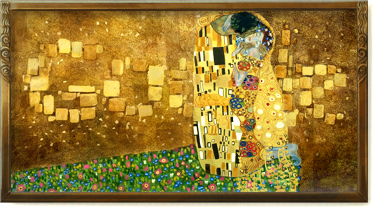
The Kiss by Gustav Klimt

The Kiss by Gustav Klimt

Copyright 2002 by Rev. Resa Eileen Raven

Invocation: Chapter 2, Verse 112 of the Quran, the Holy Book of Islam

Only he who surrenders to God with all of his heart, and also does good, will find his reward with his Lord, and will have no fear or regret.

The Jews say—“The Christians are not right.” And the Christians say: The Jews are in the wrong.” Yet both read the scriptures.
God alone will judge between them in their differences on the Day of Reckoning.

And who is more unjust then he who prohibits the name of God being used in his mosques, who hurries to despoil them even though he has no right to enter them, except in reverence.

To God belong the East and the West.
Wherever you turn the glory of God is everywhere.

God, the Creator

From the sermon given at the Spring Equinox Worship Service, March 23, 2003.

In this, the first of our year’s services devoted to creativity, we will be focusing on the idea of God the Creator.

I thought I would start out by talking a little about what I mean when I use the word creativity.  Usually when people use the word creativity, they apply it to people who are involved with certain occupations or activities, such as musicians or architects, writers or actors.  Creativity conjures up images of gifted individuals, people we think of as “artists,” who create an object of some sort:  a painting, a sculpture, a song or musical piece that can be reduced to a sheet of music.

Too often we think that for someone to be considered creative, they should be an individual with extraordinary talent who contributes something tangible to the world, something that appeals to our senses, something that can be heard, felt, tasted or seen.  Sometimes, we are a bit more charitable and we label as creative an individual who is more of an ordinary person but one who puts their heart and soul into creating an object of admiration.  We might consider the housewife who consistently serves her family gourmet meals, or the hobbyist who produces birdhouses out of old barn wood in his garage as creative people.  But in any case, creativity gets associated with things of the physical.  In our physical world, creativity is a trait that is primarily validated if it results in physical matter.

Creative Energy is a powerful force, whether raw or engineered.

Creative Energy is a powerful force, whether raw or engineered.

In reality, creativity is a spiritual trait that may or may not manifest into physical matter.  Creative energy is the basic building block of the universe.  Scientists tell us that all matter is comprised of small bits or waves that form atoms, particles that we cannot see smell, taste, feel, hear, or see, at least with our naked eyes.  We accept the belief that atoms exist, nonetheless.  So too, all of spiritual reality results from creative energy in some form or fashion.  All of life reflects the infinite possibilities that exist as a result of the variations of vibrations originating from creative energy.  God, the Creator of everything and everyone in our universe, created us in unimaginable variety, and created us in its image.  That is to say that we reflect our origin, and our origin is creative beyond our wildest imagination.  Creativity is our birthright, it is our heritage, it is our natural state of being.  Creativity is not extraordinary.  It is very much ordinary.

When we look around us at the world, at first it does not seem to be a world full of creativity.  It is a harsh world out there, one full of pain and ugliness, fear, and despair, hatred, and other debilitating energies.  It’s easy to understand why we would want to focus only on noticing our creativity when it results in great works of art or music.  Those are usually the bright spots in the otherwise dark reality of the world we have created.  We like to notice our creativity when it results in things we like.  We don’t like to notice it when it results in things we don’t like.

But we have created it all, the bad and the good, the ugly as well as the beautiful, the pain as well as the joy, the war as well as the peace.  God so loved and continues to loves us that our Creator also gave us one of the greatest gifts of all:  free will, or dominion, as it is known in the passage I will read you from Genesis later in this service.  We get to create anything we want, including hell on Earth, if that suits our needs.

We are all spirit and we all have an infinite ability to create our lives.  The single Mom in Topeka, Kansas who struggles to raise five kids on welfare may not feel very creative, but each and every day that she gets through requires tremendous creative energy on her part.  The homeless guy in downtown Olympia whose day is spent in pursuit of a warm place to be in between meals at Bread and Roses and a cot at the Salvation Army is exercising his creativity in the service of his survival.  He may not be producing a work of art that will be present after he leaves this physical plane, but his creativity is no less valid than that of Pablo Picasso; and is certainly more relevant to his own needs.  Each and every individual soul gets to decide what type of life experience he or she wants, and is given enough creative energy in pursuit of that experience.

As I was thinking about what I wanted to create through this sermon, I found my thoughts often wandering to examination of the issue of the one-to-one correspondence of life.  The Bible tells us that we are created in God’s image.  But as a species, we have a tendency to turn that around, and try to force the physical to dominate the spiritual.  In our arrogance, we’d rather think about it as God being created in our image.  And so, the history of religion is the history of people trying to remake God as a reflection of our view of humanity, whatever that view is in that country or culture.

Cave Painting, circa 15,000 BC

Cave Painting, circa 15,000 BC

Archeologists tell us that religion and art began during the same time period, in other words, around the time that our physical bodies transitioned from a four-legged species to a two-legged naked ape.  As soon as we became distinctly human, we created.  We created images of the world around us in our cave paintings.  And we created religions, religions that were primarily devoted to nature.  The first images of the divine were an attempt to acknowledge God in the physical world around us.  God was not some gray-haired white dude with a beard sitting in the clouds.  At least not for several thousands of years.  Initially, God was the sun and the moon and the stars, and the wind, and the rain, lakes and rivers and the harvest, and the animals.  And the divine came not only in many forms but did so simultaneously.  There were Gods everywhere, not just a God.  As a group, we were learning to live through physical matter, and validated the creative source around and in us, by acknowledging life everywhere.

Cherokee Corn Mother

Cherokee Corn Mother

As groups of humans began to transition into human civilizations, our images of the divine also began to transition.  The Gods of early cultures were amazingly human.  They were imbibed with human emotion, often consumed with lust, greed, petty rivalries and sexual jealousy.  The Old Testament, the foundation for the Judeo-Christian tradition with which most of us were raised, essentially spoke of several Gods, albeit by talking about several “aspects” of one God.  The God of the Old Testament physically walked and talked with us mere mortals, was demanding, competitive, jealous and seemingly arbitrary, and functioned primarily as a tribal deity.  In this latter capacity, this very human image of God was designed to protect favored groups of people and punish others with a great deal of vindictive violence.  It is no coincidence that we created this God in our image during a time in our history in which there were increasing numbers of humans on Earth, and increasing opportunities for intercultural strife.

Rape of Persephone (by Greek God Hades) by Alessandro Allori (1536-1607)

Rape of Persephone (by Greek God Hades) painted by Alessandro Allori (1536-1607)

As human society further evolved, so did our concepts about the divine.  In the Western part of the world, we made the leap to an image of one God who, at least theoretically, created all of the universe.  The three great monotheistic religions–Judaism, Christianity, and Islam–eventually came down strongly on the side of the argument that there is only one God.  Unfortunately, the followers of each religious tradition were not able to imagine this deity as embracing all.  To this day, adherents of these faiths still have largely not let go of the “tribal thinking” part of their earlier belief systems.  The God for each of these religions tends to be held out as one which favors and protects that part of the universe which is inhabited by that particular set of followers, to the detriment of other humans.

I think that the current conflict between Iraq and the United States is due, in large part, to the need of both countries to battle for supremacy of their mutually-exclusive tribal-based belief systems.  It is my sincere hope that out of this war will come the understanding that God favors no one.  God simply is.  Or said another way, God favors everyone.  Hopefully increasing number of people will understand that our salvation comes when we allow God to create through our lives, as opposed to attempting to force a human agenda upon God through our images of the Creator-of-Us-All.  We need to grow up further.  We need to learn to approach the divine from a more realistic, humbled spiritual perspective, rather than a distinctly human ego-based one.

Black Hole

The magical strength, beauty and mystery of a Black Hole as seen by powerful telescope.

In the meantime, if you would like to think of God as a wise old man in the sky, feel free.  If you would prefer to think of a Goddess who is a matriarch with pregnant-like creativity, feel free. If you would like to think of the divine as absent in our reality, like the Sky God of many aborigine tribes, or even as absent as an atheist might consider absence, feel free.  If you would like to think of God as simply nature, so be it.  Here at the Church of the Harvest you can connect and communicate with the creative source of the universe any way you wish as long as you do not interfere with the connection or communication of others.  God bless you and keep you as you exercise your God-given creative energy in pursuit of your own dreams.

Copyright 2003 by Rev. Resa Eileen Raven

The Golden Rule

From a sermon given Summer Solstice Service 2002:

Today’s program is the second in our series this year focusing on the concept of peace.  My sermon this morning is about the Golden Rule.

The Golden Rule, of course, is the name that has been given to a very pivotal teaching in Christianity—the concept of doing onto others as you would have them do to you.

This concept is not unique to Christian-based religions.  We know that it comes from spirit because it is a truth that flows through most, if not all religious traditions and faiths.  I’ve collected a few versions of this same teaching from various religions to show you the universal nature of the Golden Rule.  I’d like to read these for you now.


Golden Rule

Hurt Not Others With That Which Pains Yourself.  (Buddhism).

Treat Others As you Would Yourself Be Treated.   (Hinduism)

What You Yourself Hate, Do to No Man  (Judaism)

Live in Harmony, For We Are All Related  (Native American)

Do Unto All Man As You Would Wish To Have Done Unto You (Islam)

One Word Sums Up the Basis of All Good Conduct:  Loving Kindness.  Do Not Do to Others What You Would Not Want Done to Yourself  (Confucianism)

As you can see, even the words are similar to the ones with which most of us are familiar, i.e. the words of Jesus of Nazareth.  This version is from Matthew, Chapter 7, Verse 12:

Whatever you wish men to do for you, do likewise also for them; for this is the law and the prophets.

Parenthetically, I think it is interesting that we have intuitively labeled this concept the Golden Rule.  If you think of it, very few of Jesus’s other teachings or sayings ended up acquiring a label.  And why this one?  Most people have very little awareness of the significance of this particular label.  What I believe is that one of the Christ’s greatest gifts to us was that he channeled to the Earth for the first time, a particularly high, miraculously healing vibration of energy, a vibration which when seen on a clairvoyant level appears golden in color.  I think the label itself tells us that the energy around the Golden Rule truly is something that if we accept it, transforms us, transforms our very bodies, our very souls, bringing us to a higher place.

Gold_Metal_Leaf_by_Enchantedgal_Stock

Although the words that Jesus used in the Golden Rule were traditional and familiar to people around the world during and subsequent to his lifetime, the energy behind them was new.  I believe that he did bring this spiritual truth to a new level.  In fact, his message was radical, even revolutionary.  And like many of the Christ’s teachings, 2000 years later we still struggle to have some genuine understanding of that to which he was referring with his simple words.  Spiritually based words are like that: straight-forward but so profound as to be endless in consequence and meaning.  To understand those words better, I would like to go back and tell you more about the historical context of them, particularly that part of the historical context that has been forgotten by those of us currently incarnated in twenty-first century United States.

Jesus was a Jew.  He was part of a society, a culture, a people who traditionally held lively, sometimes fierce debates among its members about all aspects of their religion.  There were several prominent sects of the Jewish people at that time and they were quite divergent in their beliefs.  The people tended to be very passionate about their belief system.  Arguing about differing ideology was the norm.  It was not uncommon for Jewish men to die for their beliefs, even though any particular Jewish man might hold ideas that were fundamentally different from another particular Jew within the same sect.  Nonetheless, most Jews came together as a people during holy times and worshiped in the same temple.

In modern America, we don’t really have an equivalent experience.  We might theoretically acknowledge, for example, that a Jehovah’s Witness, a Catholic, a Southern Baptist, a Seventh Day Adventist, and a Pentecostal are all Christians, but we would never come together at one worship service in the same church or temple at the end of the day.  When it comes to religion, our tradition is to go our separate ways and pretend the people with whom we don’t agree don’t exist unless we are badmouthing them in private company.

Jesus had the challenge of trying to reach all these conflicted, often argumentative, sometimes openly hostile people, Jews and non Jews alike, during the same public talks with his messages about love, peace, and the essential nature of God.  He tried to find words that would help his listeners transcend their surface differences and enter the world of spirit, where all is unconditionally accepted.  And he tried to do this with crowds who were often full of individuals quite determined to trying to pull him into fragmenting debates about religious dogma.

He was confronted for example by the Sadducees, who were a prominent Jewish sect that tended to approach sacred Jewish writings concretely and interpret them literally, in a similar fashion to how fundamentalist Christians often approach the Christian Bible in today’s times.  The challenge for Jesus, then, was to find ways to talk about traditional Jewish teachings that illuminated the spirit behind them without alienating people who, in their ignorance, wanted to impose their limited understanding of the words onto others in the form of rules.

Out of this dilemma came the teaching that we know as the Golden Rule.  This rule states that there are no rules as important as the mandate to love fully and unconditionally.  Let me read you the passage that I think best illustrate the master’s teachings in this regard.  It is from Mark, Chapter 12, Verses 30 and 31.  In this scripture, a man described in the Bible only as a “scribe” overhears Jesus during one of his public debates and thinks Jesus is giving good answers.  As a result, the man decides to ask Jesus a tricky question about Jewish law.  Of all the topics about which the Jews debated with each other, arguments about the extensive and frequently contradictory Jewish law often generated the most heat, the most calls for absolute adherence to whichever position the speaker upheld.  Jesus responded unequivocally with the following directive, a position that paradoxically is both absolute and flexible–read non-rule-bound–at the same time.

      You must love the Lord your God with all your heart and mind and with all your might; this is the first commandment.

      And the second is like to it.  You must love your neighbor as yourself. 

      There is no other commandment greater than these.      

What I hear Jesus saying is that the only thing that really matters is that each of us commit ourselves totally, that is commit all of our energy or what is referred to in this passage as our “might,” to God.  We are enjoined to make that commitment with the use of heart and mind.  In the words that we use around here in this church, we are advised to commit to the indwelling personal divine, the God of our Heart.

Glory Window at the Chapel of Thanksgiving, Dallas, Texas

Glory Window at the Chapel of Thanksgiving, Dallas, Texas

Further, Jesus tells each of us to commit ourselves totally to the unconditional acceptance and love of all around us.  Not just the nice people or the people who do things for us, or the people we know, but all those geographically near to us, i.e. all of those with whom we come in contact.  And he slips in a great Truth.  He articulates that loving the other folks in our world is pretty much the same thing as loving God.

Please notice the subtle underlying progression in his words.  I believe the movement of the sentence supports the idea that learning to love God completely leads to learning to love oneself as a child or aspect of God which in turn leads to loving other children/aspects of God.  But Jesus seems to say that sometimes you have to consciously commit to loving others. You can’t just wait until you’ve got it straight with God; and only then get around to taking on the task of improving your relationship to your fellow human being.  Even though ultimately, loving others is the natural progression of learning to love God, for most of us it takes a conscious choice, an act of willpower, to love some individuals in our world.  It can be hard work.

If we do these two things—follow the God of our Heart unfailingly, and love others unconditionally–everything else will fall into place.

During this period of strife in the world-at-large, let us take heed of the teaching of the master.  I urge you to use every opportunity to find the God within, both in and out of your meditations.   Translate the love that will naturally grow over time from alignment with our Creator to your thoughts, words, and actions towards the people in the world now, irrespective of whether or not they “deserve” it.  Don’t wait to love people until it is the easy next step in your development.  Do it now. Choose unconditional acceptance and care for the well-being of others, even the people that mistreat or abuse you.  The rest will take care of itself.

Copyright 2002 by Rev. Resa Eileen Raven

Prosperity

From a sermon given June 1999 at the Summer Solstice Worship Service:

Prosperity is a very hot topic these days here on Planet Earth.  Many people seek it, even in these days of dwindling resources when people are increasingly aware that there is a limit to what is provided by the Universe free of charge to those of us playing the game of life.  So I thought I’d spend a few minutes this morning talking about my views on what prosperity is and more importantly, what it is not.  Usually it’s easier to find something when you understand what you are looking for.

Until lately, the topic of prosperity hasn’t interested me much.  Like many of us, I was raised in a family and a community that was built on a foundation of scarcity, despite outward indicators of abundance.  There was always food on the table and money for basic necessities but there was also the unspoken sense that the outward stuff could disappear at any moment.  Both my parents had barely survived the Great Depression in the United States, so they were uneasy with their new-found economic advantages.  But as a kid, I was more focused on their uneasiness than the source of it.  I had many basic questions such as why my father worked so hard he didn’t have any time for his children, even though he clearly loved them; and why my mother didn’t seem to enjoy anything about her life, even though she seemed to have everything moms were said to need.  Although I didn’t have the words for it as a child, I was tuned into the poverty of spirit around me.  In a sense, I have been dealing with prosperity, or its alter ego poverty, all my life.  I just haven’t been very interested in the monetary aspect of it until more recently.

I first began to look more deeply at the concept of prosperity about fifteen years ago when I was going through the seminary.  At that time I belonged to a church full of very insightful, interesting and powerful people who were teaching me the basics of working with energy–my own, other people’s and the energy of the universe.  At some point a workshop on Prosperity was scheduled that I was not planning to attend but about which many of the people around me were excited.  And then, expectantly, it was canceled.  And the word came down through the ranks that the church leadership were not able to handle the energy from the workshop.  Now THAT got my attention.  Here were some of the bravest, most talented people I had ever met who were doing amazing things, performing miracles on a daily basis, but who were saying that they did not have what it took to deal with the topic of prosperity.  It was then that I realized that prosperity is a concept of great depth.

Since that time I have paid attention to how prosperity gets played out in our shared world.  I am here this morning to tell you about three conclusions I have reached in the last fifteen years, three principles if you will, principles that I believe are true.

prosperity2

First of all, Prosperity is about wealth of the spirit, not wealth of the body.

This is very important to understand.  Perhaps you have run across one of the thousands of courses, classes, workshops, study groups, organizations, or whatever, that exist in the community that purport to teach people how to create monetary wealth.  Sadly, there are even entire “prosperity churches” that are dedicated to this goal.

If you are in need of money, taking a class on such physical aspects as how to play the stock market, set up savings plans, buy real estate or whatever, may be a good idea for you.  Just don’t delude yourself into thinking that what you are doing is increasing your prosperity.  You may be increasing your monetary resources, which may or may not be a good thing for your overall spiritual development.  But this has little or no connection to your real prosperity level.  People can have a lot of money and no prosperity.  Conversely, people have little or no material resources but an abundant and dynamic prosperity.

Prosperity is about inner wealth, a sense of richness in one’s lived experience.

What I call “true prosperity” is having the experiences that you as spirit want to be having in your life to learn what you came here to learn. . .and if it takes money for you to have those experiences, so be it.

prosperity3

Second of all, Prosperity comes with a price.

We don’t like to hear that.  Indeed, this a message that is almost entirely absent in all those thousands of courses, classes, workshops, study groups, organizations that are often so happy to take your money to teach you how to be prosperous.  We prefer to think of prosperity as a free lunch.  It’s not at all free.  What is the price of prosperity?  Responsibility, of course.

“True” prosperity is a manifestation of energy, like everything else.  If you have a lot of it, you are necessarily gong to be dealing with a lot of energy.  The more you have, the more you must take care of, must work with responsibly. . .or you lose it.  The universe gives freely to those who wish to receive, but it also takes back–eventually if not right away–what is misused, taken by those who cannot handle the gift, or otherwise received ungraciously.

If you can’t handle the responsibility of increased prosperity, you will find that people rush in to take it from you or control you through it.  control

Or you may develop an illness that uses up all those resources, or whatever.  I’m reminded of all the lottery winners who end up dying of a heart attack or something shortly after their win.

It’s not a question that somehow you didn’t “deserve” that increased level of resources.  The universe is much more fair than that.  It’s only a question of the energy flowing to where it ultimately can best be utilized.  Think of true prosperity as a raging river.  You can dam it up or try to divert it to something other than its natural causeway and sometimes, if you’re in sync enough with nature and you’ve taken the time to do the necessary engineering and environmental studies, that may work.  If you haven’t done your work or you’re trying to force something unnatural onto the Earth, the river will overflow its new banks, become stagnant, or otherwise have problems.

In this case, “doing the work” means spending the time getting to know yourself and your spiritual purpose; and if you truly require a large amount of material resources in order to serve that purpose, being prepared to pay the price of living life on a raging river.

prosperity1

Third of all, All prosperity comes from God, and all true prosperity is in the service of God.

The creator knows no lack.  Nonetheless, that infinite wisdom allows us to create scarcity because of its endless love for us and perhaps its greatest gift to us:  the gift of free will.  People ask me all the time:  isn’t abundance limitless?  God has no limits; but we do.  And sometimes we impose those limits on ourselves for reasons that make sense even to us, if we were honest with ourselves.  And sometimes we impose those limits on ourselves for reasons that we are not yet willing and/or capable of understanding.  And sometimes we impose those limits because we are lost.

It’s all up to us.

We get to be rich in spirit or impoverished, depending on our soul’s desire and that choices we make in trying to bring that desire to fruition.  Not coincidentally, we get to be rich in physical resources or impoverished, depending on what we are trying to learn, want to experience and the choices we make in creating that experience.

Only you can examine your conscience, and discover what your prosperity needs to be to accomplish your purpose in life.

I’d like to end my sermon this morning with the words that I was drawn to last year after praying for several days for insight about the name of this new church that we were about to incorporate.  I woke up one morning knowing the name was in Luke, Chapter 10, Verse 2:

The harvest truly is great, but the laborers are few.

Pray thee therefore to the Lord of the harvest.

That he would send for the laborers into his harvest.

Copyright 1999  Rev. Resa Eileen Raven

The Economy I: Where We’re Coming From

This article was written by the Rev. Resa Eileen Raven and published for the first time in March 2010 in a blog entitled “Ravings from the Rev”:

Last month Newsweek contained an interesting article that was called “May the Best Theory Win: How Economists Are Competing to Make Sense of Our Failed Financial System.” Basically the article was about how none of our existing belief systems can account for the current economic climate. They all are short of the mark, leaving those of us trying to weather the economy massively confused and frightened, and decision-makers clueless about how to get us out of the slump.

I always like it when the powers-to-be can honestly admit their ignorance, but the thing that really caught my eye was the article’s characterization of economists as doing a lot of “soul-searching.”

“Soul searching”–what an interesting choice of words. Maybe it is a stereotype of mine but I don’t think of economists as having much interest in or knowledge about soul. And yet. . .soul really is what is going on right now in regard to the economy.

To be fair, I don’t think those of us who have interested in soul for our part have had a lot of interest in the economy. There is a reason why Jesus of Nazareth talked about it being harder for a camel to go through the eye of a needle than a rich man to get into Heaven. . .and why, when he threw his one and only hissy fit of record, it was directed at a marketplace. Spiritually, you can lose yourself very easily if you get caught up in the exchange of money for goods and services. For many of us truly committed to our spirituality, focusing on money hasn’t been worth the risk. But I believe that this is the time for those of us who value the spiritual path to also learn to pay attention to economic issues, if for no other reason than to put them in their proper place.

For nearly two million years, human beings were tribal, nomadic, and completely preoccupied with survival in an immediate sense. It was primarily with the rise of early human civilizations some 8000 years ago, when we transformed from hunters/gatherers, that we developed the first “economies.” Farming the land, domesticating animals, constructing salt mines to preserve food, all these allowed people to have more than they needed at times, to accumulate “wealth.”  Folks could then trade with people outside of their own family/clan/tribe. Agricultural-based societies always eventually created a marketplace where people could swap things they did not want or need, with other things their neighbors offered.

marketplace

This production of “wealth” came with advantages and disadvantages. It had the obvious benefit of accumulating enough to meet the basics of life and a little extra to make life sweeter. It allowed individuals to exercise their God-given creativity. But it also provided opportunities for some to exercise greed, and/or exert control over their neighbors through the granting or withholding of resources, in a way that would not have been as tolerated in a more collectivistic hunter/gatherer society.

Anthropologists tell us that hunter/gatherer societies are almost always egalitarian in structure, whereas agricultural/industrial societies organize their members hierarchically. Counsels of elders and clan leaders eventually gave way to leadership by warlords and theocratic/civil governments who had the authority to intervene in human life but were often far removed from the real consequences of those interventions.   Whoever held the political reins could advance their economic interests to the detriment of others not in power, and they could do so without having to see, feel or hear from the people affected by their decisions.

For example, in 200 BCE, when the feudal kingdoms of China were united into one country, making China arguably the most advanced civilization on Earth at the time, its rulers could declare that all the iron and salt in the land belonged to them because they had to build a Great Wall to keep out the Huns. Businesses that needed iron had to pay exorbitant prices for it, forcing hundreds to lose their livelihood; and thousands of people who couldn’t afford the salt tax and therefore had no way of preserving food for the winter, were left to starve. This is one of the first of many examples of price-fixing and government monopolies leading to real suffering by those not at the top of the hierarchy.

salt pix

So what has this got to do with the economy today? Understand that there is a lot of history here, a lot of energy that has gone into our current economic dilemmas. We’ve been lost for a long time. For thousands of years, 8000 more or less, we’ve increasingly based our lifestyles, our political structures and our marketplaces on the acquisition of wealth and the physically-based needs that it can feed: glory, power, status, and hedonistic pursuits. Fair exchanges of goods and services in order to share with each other, has been an increasingly rare experience.

We’ve largely squandered the Earth’s once abundant resources, and have tried God’s patience enormously. During this time of great balancing, there is a lot to put right. And a lot of new ways of thinking will be required.

Copyright 2010  Rev. Resa Eileen Raven

Angels and Devils: The True Nature of Good and Evil

angels

From a sermon given September 2002 at the Fall Equinox Worship Service

When we originally picked the topic for this service, I had no idea it was such a controversial one. I just thought it would fun to look at one manifestation of a great roadblock that faces individuals and society as a whole who are trying to find peace. That is: the tendency of all of us to divide the world into good and evil.

Planet Earth really is a world of dichotomies; a vast playground full of polarized opposites. It is our job to notice these opposites and learn to choose the middle ground, the high ground so to speak. Other places in the universe do not provide this same challenge of polar opposites. The overarching defining principle of Planet Earth is that we have been gifted with free will. To maximize the learning process upon which we are all engaged, it is helpful for us to be presented with a wide range of opportunities so that we can learn to make choices that are productive and in keeping with divine intention. We are constantly given choices that involve one extreme or another. Thereby we can choose, if we want, to find the balanced perspective in between the extremes. That middle ground is where the peace lies, the inner peace for individuals; and the outward manifestation of it–the peaceful coexistence for groups of individuals.

The tendency for we humans to dichotomize runs so deep that we create situation after situation of “us versus them” in the world at large. As humans, our very brains become accustomed to, and find it most familiar to process the world from an either-or perspective. That same tendency runs deep enough in our basic makeup that we even dichotomize the world of spirit, much as we dichotomize the material world. Thus, in most religious traditions there exists angels, who are the good guys; and devils, who are the bad guys. Sometimes the latter are talked about as fallen angels, acknowledging that they are simply a point in a continuum; and sometimes they are seen as a class of villains by themselves with no particular angelic etiology.

It’s been many years since I looked at the concept of angels and devils. I deal with the spirit world on a daily basis, but I use other filters with which to view that reality. So to prepare for this sermon, and reacquaint myself with how many or most people think about angels and devils, I did what any good researcher would do: I watched a lot of movies.

There is a plethora of messages about the spirit world coming through these days. In this time and place, as the heavens and earth move ever closer together, and the basic fabric of the time-space continuum transforms, our culture is flooded with spiritual images and archetypes to which many people are exposed, often without any real awareness of what it all means. Angels and devils are everywhere in increasing amounts—not just confined to paintings in museums or gargoyles on structures built in medieval times; but on key chains and other knickknacks, and Hallmark cards, and on television, shoes, and rock songs. I am told, angels are mentioned in one out of every ten popular songs. However, movies are one of my favorite ways of tuning into popular culture, so I will start there.

There are some great movies out there that work us over on a subliminal level in a positive direction. I would recommend three in particular:  Michael, in which John Travolta plays a beer-drinking, ball-scratching, bull-fighting babe magnet as the Angel of Destruction. Then there is Devil’s Advocate, in which Al Pacino is a magnificent Lucifer trying to charm an attorney played by Keanu Reeves into fathering the Anti-christ. And my personal favorite is Dogma, a movie that was subjected to a concerted boycott by fundamental Christian groups, always a good sign. Armageddon is the main event in Dogma, with Ben Affleck and Matt Damon playing fallen angels, the talented Alan Rickman as one of the angels on the right hand of God, and George Carlin with a short stint as a Catholic cardinal who doesn’t even get that the battle is raging.

Hollywood movies, as fun as they are and as important as they are at both reflecting and shaping our thought processes, are considered only entertainment. So I also did research into how most people are viewing the subject of devils and angels by reading various serious popular and religious texts. And that’s where the real fun begins. Because, as with most aspects of spirituality, people are all over the map. There is no consensus about the nature of the spiritual beings we call angels and devils.

As it turns out, the Christian Bible, that ultimate source document for many people in the United States, is strangely quiet on this subject. Although there are a number of references to angels, there are very few actual details contained therein. In the accepted scriptures of the God of the Judeo-Christian tradition , there are angels who exist to worship God, and angels who are sent out by him to protect, destroy, or carry messages to mankind. But we do not know much about who these beings are, where they live, or what they typically do in an ordinary angel day. There are only two angels who are actually named in the Bible: Michael, and Gabriel. This is not very much information about beings than are generally considered to be more numerous than the stars. I am told that in the 14th century, the number of angels was calculated by certain segments of Christianity as numbering 301, 655, 722.

Information about devils in the Bible is also largely or wholly missing. Satan is mentioned sporadically. In the Old Testament he is more in the role of a prosecuting attorney in ongoing theological debates than an evil figure. In the New Testament, he is certainly not the tunnel-visioned, stand-alone, cartoon-like figure that is portrayed by many present-day Christians.

For example, in Matthew, Chapter 17, Jesus of Nazareth has a disagreement with Simon Peter. This is directly after Jesus has told Peter that Peter is the rock upon which Jesus’s church will be built, so obviously within the context of Jesus having a great deal of faith in Peter and his abilities. Jesus tells his disciples that he will soon be crucified, and Peter tells Jesus that this isn’t going to happen. Jesus says to Peter, you are thinking from the ways of man, not God; get out of the way, Satan. What I hear from this story is Jesus’s acknowledgment that even the strongest and brightest of us can have energy not aligned with God. I do not hear validation for a separate being which we might simplistically call “the Devil.”

There is actually, a lot of information about angels and devils out there in popular literature and apocryphal or noncanonical literature, but none of the world’s religions seem to have a consistent, coherent stance on the subject. In polytheistic systems of religious belief, there seems to be more mention of but less focus on angels and devils, probably because when you base religions on inward meditation and not outward-based truth-seeking, you have less need for intermediary spirits between an individual soul and the Cosmic Consciousness.

In all the great monotheistic religions, devils and angels galore exist, but also a great deal of controversy about them, even within each church or religious denomination. Even in Hinduism, Buddhism, Jainism, and the like, there are many acknowledged spirits or devas that pursue out good or bad ends.

At various times in various ways Jews, Christians, and Muslims have all gone through periods of awakening interest in the functioning of the spirit world; followed by periods of anxiety that acknowledgement and exploration of the spirit world will lead to an undermining or destruction of faith in the teachings of the church; followed by further periods of rediscovering sacred literature about angels and devils; followed by further rejection by church leaders in the populace’s interest in these entities, etc.

For the record, I will tell you that personally, I do believe that there are spirits that will assist us in following God’s will, if we choose to avail ourselves of their assistance, spirits that might accurately be labeled “angels.” In the words of the 91rst Psalm, Verses 10-11:

He will give his angels charge of you,
To guard you in all your ways.
On their hands they will bear you up,
Lest you dash your foot against a stone.

I don’t know about you, but I am very prone to dashing my feet against stone, and consequently am quite glad for the assistance of the spirit world, which I receive freely when I remember to call upon them.

I also believe that there are spirits who are more than willing to encourage us in making choices that are detours on our path back to God, many who are simply curious or mischievous; and a few that rise to the level that might be called evil. The former could be called devils and the latter “the Devil,” if you prefer that terminology.

Ultimately, however, it is our choice who we hang out and allow around us, and who we follow–whether they have a body they work through or not. Because we have free will. We demand of the substance abuser that if they claim to be sincere in controlling their drug-seeking behavior, they must surround themselves with those who will support patterns of sobriety and other pro-social behavior. So too, is it up to us to surround ourselves with those who will lead us to the righteous pathway. When we can acknowledge the self-responsibility that derives from our free will from a place of awareness and a place of nonjudgment, than we can make clearer and more productive choices that are the more direct route to the true peace that comes only from connection to our Source.

So what is the True Nature of Good and Evil? You know me. Of course, I’m not going to impose my truth upon you. Feel free to discover your answers in your meditations over time. But I would like to leave you now with an interesting tidbit I ran across in my research. According to Malcolm Godwin, who wrote a book called Angels:  An Endangered Species, among the stories about the war between the angels in heaven in various Christian texts, there was one version that was suppressed by the Catholic Church. In this version of genesis or the apocalypse or whenever this war supposedly takes place, there were three groups of angels, not two. One-third sides with God, one-third with the Devil, and one-third chooses to stay out of the conflict. Reportedly it was this third group of angels, the ones who chose neutrality, the not-very-bad but not-very-good-ones, who later bring the Holy Grail to Earth.

Copyright 2002  Rev. Resa Eileen Raven