From a Sermon given Fall Equinox Worship Service September 29, 2019
Over the years I’ve been blessed to have the opportunity to learn many things in my role preparing sermons for this Church community. Most of the time my words have been appreciated and gracefully received by people coming to the worship services. I have noticed however, that whenever I venture into talking about money or economics in general people often go into anxiety, resistance and on one occasion even outright hostility.

Rationalization is the norm any time the talk turns to money. Cartoon used in accordance with Fair Use Principles.
I can almost see the fear pictures flying through the air for the people with less resources; and the boredom aka resistance pictures for the people with a good amount of resources who don’t want to think about that it might ever be otherwise.
So let’s get something straight from the start, shall we? We are going to talking about the “new economic norm” that has been unfolding in stages and will now rapidly be manifesting in the United States right now.

Countries around the world have suffered from an inadequate amount of resources for day-to-day living for several decades and this inequality is exponentially increasing under climate change. This is an image of Bhatapur, Nepal after a quake. Picture used in accordance with Fair Use Principles.
We are no longer living in a time of shrinking resources. The resources have shrunk and many have shriveled up and are starting to be blown away with the same earthquakes and hurricane forces that have been ravaging our landmasses and oceans.
People, we are going to be experiencing some really lean times unlike anything we have known in our country in our lifetimes. Historically we’ve seen it before, like during the Great Depression, but not recently, not in the lived experience of the people in this room. It is going to be challenging for ALL of us, albeit in different ways. This time around, none of us will escape the consequences of our new way of living in the world, not even the rich folks.

There is no part of the planet, no underground bunker or gated community that will protect human animals from the effects of climate change, “Warming” by Shayla Maddox. Art used in accordance with Fair Use Principles.
Hopefully by the end of the service and in the next few days however, you will find yourself beginning to view this time of austerity as nothing to be feared, something that is necessary and maybe even in certain ways a good thing.
So let’s put on our big boy pants and see if we can raise the level of our awareness from the physical to the spiritual in how we view one of the last and most fear-provoking of the changes our world is undergoing right now. And when I say world I mean the whole world, but my emphasis this morning is on the United States. What is happening economically is certainly global in character, but in some ways we in this country have the most to deal with energetically because we have had the most.
After World War 2 the United States moved into the position of being the prominent peace-keeper of the entire world on the surface; as well as the most aggressive war monger out of view through our role as the world’s premier arms dealer.

Every country has its own energy. This depiction from Christian Chinese American artist He Qi depicts the essence of the United States of America as Peace and Freedom. Picture used in accordance with Fair Use Principles.
We amassed great financial wealth through participation with conflicts on every continent. This was our national destiny so to speak, and we played it out well, with the implicit energetic support of people everywhere. We set the energy but the world created the scenarios with us and followed our lead.
 On the physical level the American dollar became “the almighty dollar.” Our lifestyle was the envy of the world. Everyone wanted to be a part of the American dream in which those with few resources could rapidly transverse into a higher socioeconomic class. Unfortunately, as we transformed ourselves into a country of great material wealth and political status, as a country we essentially did the collective version of getting lost to our ego, aka our perfect pictures.
In the last few decades people would occasionally engage in intellectual talk about the fact that the United States was consuming 80% of the world’s resources even though we were only 20% of its population; or the fact that we were competing with each other to waste much of this material wealth in lavish display of conspicuous consumption. There were a few conversations now and then about the fact that this level of consumption and waste was not environmentally sustainable. For the most part though, most Americans continued to buy stupid stuff and throw it away at the first opportunity for something better; worked very hard at not noticing the far-reaching effects of our individual and collective choices; and continued to ignore the cost of our lavish lifestyle on ourselves, each other, those in other countries and on Mother Earth.

Cat in the Hat by Dr. Seuss. Image used in accordance with Fair Use Principles.
These days one of my favorite synonyms for the Creator-of-Us-All is the “Great Equalizer.” It is the time of the Great Balancing when all will be called to task. The United States has been on the highest rung of the economic pedestal of the world for about 70 years now, so our fall back to Earth has the potential for being the most jarring, the most painful. Like everything else about how we create spiritually through matter however, it is up to us, up to choices we make through our free will.
To talk this morning about how we can cushion our fall and maybe even tumble in a manner that allows us to pop right back up, I’d like to switch it up and focus on spirit, and what we know about economics from a spiritual perspective. For this I’m going to use the Christian Bible.
To me, one really interesting thing about what Jesus of Nazareth says about money as recorded in the Bible is how much he says. As I understand it, other than the “Kingdom of God” he talked more about economics than any other subject. Even taking into consideration the fact that he lived in a time period where almost all human beings were still dealing with basic survival, this is an extraordinary amount of attention paid by a religious leader to economic status.
Keep in mind though, that Jesus knew everything there is to know about how energy works on Planet Earth. He certainly knew that money is just a symbol, a stand-in for power. As the master of parables, he talked with everyday folks using stories to which they could relate, stories about food and oil for lighting and heating and other basic necessities to keep one alive. In this way he also taught people about individual and group energy and where and how to focus it.
So let’s review the overarching Truth said by Jesus as quoted in Matthew, Chapter 6, Verses 24-33:
No one can serve two masters; for a slave will either hate the one and love the other, or be devoted to the one and despise the other. You cannot serve God and wealth. . . your heavenly Father knows that you need all these things. But strive first for the kingdom of God and his righteousness, and all these things will be given to you as well.
Since the time of the Christ people have struggled to hear the messages he embedded in his stories; and in typical human fashion have frequently projected onto those words their own wishes, desires and meanings. In my opinion biblical passages about economic matters are not only among the most prolific in terms of numbers, they are also among the most distorted in terms of interpretations.
Everyone wants to cherry pick the Bible to look for justifications for their own actions. On the one hand, you have the people who want to dwell on the words of Jesus that it is easier for a camel to go through the eye of a needle than a rich man to gain eternal life. This passage is used by many and particularly I have noticed by people who are struggling with survival or jealousy and competition pictures, to conclude that all wealthy people are wrong and maybe even evil, who need to give away or have taken from them everything they own.
On the opposite side of the dichotomy you have the political and religious folks who want to dwell on Jesus saying the poor will always be among us. These are the people that say that all wealth is from God and interpret being wealthy is a sign that one has been rewarded or blessed by God. If they are more political than religious they may talk about wealth coming from hard work, good values or superior family; and demonize poor people as lazy, stupid, mentally unstable, morally corrupt, etc.
It’s all the same energy. Whether you attempt to use the words of the Christ or more secular language to rationalize economic oppression, it is all about marginalizing people without economic power. This is the injustice, the imbalance, this is the lack of righteousness that will be disappearing shortly, one way or the other, as a result of the master plan in which we are all living. This is the time and the place where the Great Equalizer will be doing its magic to help us come to our senses.
What do we need to keep in mind, to help this equalizing process go as smoothly as it can in our individual lives and the lives of those around us? Let me read this again:
No one can serve two masters; for a slave will either hate the one and love the other, or be devoted to the one and despise the other. You cannot serve God and wealth. . . your heavenly Father knows that you need all these things. But strive first for the kingdom of God and his righteousness, and all these things will be given to you as well.
Please notice two things here. Please notice that the Christ is not saying you cannot have both God and wealth. He is saying you cannot serve both God and wealth. One will invariably be the master.
Please also notice how similar this passage to what has been called the “greatest commandment,” the teaching of the Christ in Matthew 22, Verses 36-40.
Love the Lord your God will all your heart and with all your soul and with all your mind. This is the first and greatest commandment. And the second is like it: Love your neighbor as yourself.

Image of Scrooge McDuck from Carl Banks, in conjunction with DIsney, used in accordance with Fair Use Principles.
The point here is that FIRST you start with finding God, aligning yourself with God, committing yourself to God. And then you have the guidance you need to fully allow the Love that is God to flow outward to others. You get to have as much money and other resources as you need to fulfill the divine’s purpose; but if money is your master, you are in for a rude awakening .
In the coming days, the economic oppression that was such a major talking point for Jesus of Nazareth will be the focus of a world-wide turnaround as directed by his father. Everyone from the 1% that own the 30 trillion dollars of financial assets in the United States, as well as the bottom half of Americans who have less than nothing, in other words more debts than they have assets, will have to come to terms with what is the guiding principal in their life: God or ego.

Money as one physical reflection of energy, needs to flow freely and not become stagnant. An informed reading of the words of the Christ reveal that the real problem for people with economic resources results when people hoard wealth, in other words accumulate wealth beyond what they individually need or need to serve others.
Usually at this point in the sermon I would be starting to talk about the need for grounding, approaching the subject of your private economics neutrally by living in the center of your head and finding your own truth by seeking direction from the God(dess) within you in your meditations. Do that. Do all of that. But the meditators in this room know how to use these tools so I’m going to move on from here.
Because the topic of money brings up such overwhelming amount of fear and resistance for most of us, I want to share some personal cliff notes I have worked out over the years, in regards to part B, i.e. loving our neighbors as ourselves economically from a spiritual perspective.
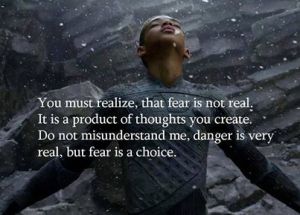
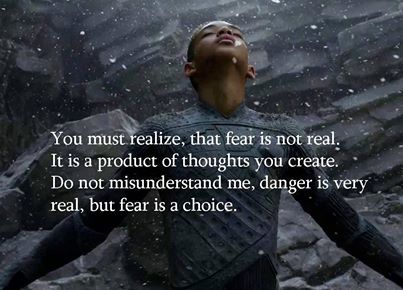
- If you fear you won’t have enough. . .work on your fear. . .because that is all it has to be. . .unless you empower it with your belief. Trust me, there is enough.
- If your life purpose requires a great deal of resources to accomplish, if it truly is a spiritual-based calling, that is to say that if you truly are co-creating with God, the resources will appear. But then remember that they are not yours, they belong to the divine.

Gratitude by Linnea Tobias. Image used in accordance with Fair Use Principles.
Give thanks for being one of the few rich people that is privileged enough to “get it.” Continue to act frugally towards yourself and remember you are simply the caretaker of the remaining wealth. That means that you will be gifting the excess you don’t need directly to others or it means you will be using the resources to build something of more long term benefit to others.
- If you catch yourself using any resources beyond basic levels on yourself, ask if you are threading a camel through the needle. . .and go back to those conversations with the God(dess) within.
You don’t have to be a Gandhi living only with a robe, food bowl and a book of sacred writings. Recent technological advances have made it possible for all of us to have a higher standard of living. Sometimes “discretionary” money spent on travel, beautiful objects, art supplies, even good but high-end food is needful for a higher purpose such as creating peace, joy, health or beauty; and sometimes it is done for escapist or prideful reasons.
 We all fail prey to our ego at times. Only you and your creator will know the difference. If you find you have let your ego rule, no problem, just do a little mid course correction and renew your commitment to using collective resources for spiritual rather than material goals.
- If you see others hoarding wealth that should be given to others, speak out and otherwise do whatever you can.
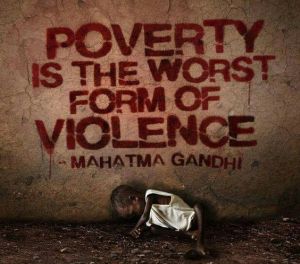 By his words and his example, the Christ was quite clear that loving your neighbor as yourself means advocating for the oppressed, the marginalized and the poor. Unfortunately this will put you in the cross-hairs of most of our religious, commercial, governmental and other collective forces. . .but it’s the least you can do.

- Understand that in the present time period things are unfolding in the manner that is needed. Do not give in to despair. We had to destroy our castles built on the sand of conditional love, no matter how painful, so that we have the means of rebuilding on the bedrock of unconditional love.
For human animals to continue our experience on this magnificent planet, for us to return to the garden, we needed to live the experience of losing our way so we had the possibility of choosing a more righteous path that recognizes that all life is connected.
Our bodies are experiencing a great amount of fear right now but if you tune into the spiritual reality you will know we stand to gain riches beyond our wildest imagining. Making it through the next stage will require that we grow up and leave behind our adolescent striving.

Image by Louisa Cannell, used in accordance with Fair Use Principles.
It will require more faith than most of us have ever had. It will require us to learn how to focus all our God-given spirit-driven abilities. But the journey can be exciting, the creativity awesome, and the resulting world truly humbling in its majesty.
It is for this reason that I entitled this sermon “Welcoming Scarcity in the New World.” Thanks be to the Great Equalizer for this marvelous opportunity.
Copyright 2019 by Rev. Dr. Resa Eileen Raven

 Church of the Harvest
You must be logged in to post a comment.