The Wintering of America

From a Sermon given Winter Solstice Worship Service 2016

Winter Solstice is the time we traditionally get together to celebrate the transition that begins at the end of the year and moves us into the beginning of the new year.  Winter is such an underappreciated season, maybe because it forces us to slow down, nudges us into reflection, sets us on the path of integration and changes to come.  It’s like Nature’s growth period, not in the biological sense of things growing, but in the spiritual sense of destroying old cycles with which we have been living; making room for new cycles that are not yet apparent.  It is a time of bareness, of winnowing the exterior world down to basic necessities, so we can look around at a blank canvas and dream about what we want to create.

This year we have the opportunity to do this reinvention not only in our individual lives, but in our collective lives.  I know of many people in America and around the world who are reeling from the shock of the election of Donald Trump to the Presidency of the United States.  They say that even most of Trump’s followers were in shock that he actually got elected.  To all who are confused, in anger or fear, or otherwise distressed, I dedicate these words.  This sermon is not about politics.  It is about life on Planet Earth and moving forward when we find ourselves in deep and unfamiliar winter territory.  uncertainty

When I woke up the day after the Election to find we now had a President-Elect Trump, I had many thoughts and feelings, many of which were unpleasant to experience to say the least.  But in the deepest part of me I found a small but very bright and very profound ribbon of gratitude.  I knew exactly what it was about.  I knew in my heart that Donald Trump was not “destined” to be President as of the day before the election.  There are very few times that I know something beyond a “shadow of a doubt.”  But I believe without a shadow of a doubt that the mockup a scant day before the election was that Clinton be elected.  We can blame the media and the pollsters all we want for not preparing us better.  There is certainly no end to the “soul-searching” that the media needs to do about their choices during the election, but they are not to blame for projecting defeat of Trump.   On a spiritual level we had decided that Clinton was going to be the “winner” oflightening-and-lava the election.

And then we changed our collective mind.

The day before, no less.

I mention this almost in passing because perhaps it will bring some solace to individuals who are still lost in the maze of the election energy.  But mainly I mention this because miracles need to be acknowledged, especially ones that are invisible to most people.

It is nothing less than a miracle that an entire nation changed its mind within 24 hours about who to let become President.  The ramifications of this energetic shift are enormous.


What it said to me is that there is hope.hope-changes-everythingYou all know that my primary focus and concern these days is on the very real possibility that human beings will not survive on Planet Earth.  In order to “weather” (pun intended) the changes we are bringing to Mother Earth in our arrogance we must make some rapid behavioral shifts in our thinking and behaving.  Further, these changes require a change in human awareness that in my darkest hours has seemed light years away.

If you have any idea of how the consensus reality works, you will recognize that apparently, enough of us have made and/or are making those changes in awareness that a massive shift in the time-space continuum is now possible.  Nothing else explains the fact that one day Trump was not slated to be President and the next day he was.  The fact that collectively so many of us can manifest an energetic shift of that magnitude in that short of a time frame means that we stand a fighting chance of surviving climate change.  And for that, my heart sings with deep gratitude to God and to all of us who are trying to learn to genuinely live consistent with its will.  This was so much bigger and more important than who occupies the Oval Office (or the Trump Tower as it may be).

Here at the Church of the Harvest we have been talking for several years about the fact that humans have constructed a world on the basis of scarcity and conditional love; and in order to move to a world based on God’s endless bounty of unconditional love many of our social, economic, religious, political, and other institutions will need to be destroyed with some being rebuilt in a far different form.  What we just did in our electoral process is greatly accelerate the timeline in terms of destruction.  I was hoping we would not have to do the destruction phase overnight because I know all too well what a hard time people have with change.  The American people decided otherwise.

Is it a good thing or a bad thing that all that we upped the stakes in terms of destruction of our world?  It remains to be seen.  We know that from a spiritual perspective there is no good or bad, just experience.

mayan-dancer-representing-an-owl-symbol-of-death-in-mayan-mythology

Death=Rebirth=Potential Wisdom. Mayan Dancer Representing an Owl, Symbol of Death in Mayan Mythology

We also know that our human brains cannot comprehend the master patterning of our Creator.  History has repeatedly revealed points in which horrible things have happened to individuals and to the world within which they live, in order that even more horrible trends are stopped in their tracks.   Think Pearl Harbor for example, where over 2,400 individual souls made the decision on a spiritual level to sacrifice their life, and another 1,000+ were injured so that the U.S. could wake up to what was happening in Nazi Germany and make a decision to enter the World War 2.

pearl-harbor

The attack on Pearl Harbor, December 7, 1941

If Pearl Harbor had not happened, it is very likely that not only all of Europe and Asia but probably our continent as well would be under occupation by National Socialism.   The destruction acceleration we just made possible in the United States can bring those who withstand it closer to each other and to Nature and therefore, to the ultimate preservation of human life.

I have been tracking the destructive trends for many years now, but the aspect of those trends that I feel drawn to discussing this morning is the perfect pictures we all have about the United States.   Most of you have heard me say that the road to Hell is paved with perfect pictures.  Perfect pictures are those insidious little bits of programming on an energy level with which all old spirits struggle, that tell us that things are supposed to be or go a certain way.   being-wrong

They create a great deal of grief in part because the world doesn’t oblige us by conforming to our pictures so we lose our way more readily.  Additionally, they generate a ton of blame, hostility, and intense fear when the world doesn’t live up to said pictures, which actively interferes with the learning that needs to happen to get closer to the ideal.  Blame and hostility:  Thinking about this election, does this sound familiar?

The United States is a place rife with perfect pictures, almost like an orchard of overripe fruit that falls from the tree and makes such a big mess that it’s hard to even walk around without falling.  The idea that this country is a new and better version of any other country on the Planet has been part of our national credo for over two centuries.  “We the People,” our “creation myth” to use a label from anthropology, did indeed reflect a giant step forward in the evolution of humanity.  Our fledgling democracy was a great achievement but contrary to the popular belief it was never a perfect one.  The “New World” as we called it, afforded some of us a chance to move beyond our history, but not all of us.

Initially the constitution of the newly formed United States primarily protected the rights of wealthy white men.  Right off the top, over half of the population could not actively participate by virtue of their sex–women.  And then there were the Africans who were not yet called “African Americans” and who were not even acknowledged as human but rather, were each designated as 3/5s of a person for the purpose of property taxes.  The over 12 million Africans who were forced into slavery by the 1900s primarily for the economic benefit of white people were missing from our national narrative of greatness. Also by the 1900s  immigrants primarily of European ancestry had  destroyed 80-98% of the indigenous Native American population through displacement, war, other forms of violence, a fact that we happily justified by the 19th century doctrine of Manifest Destiny.   In the United States, we have tried very hard to not notice that American dream was very hard on many; and that everybody in our country did not exactly have the same degree of a chance at reaping it’s rewards.

Nonetheless, the idea of America as the land of opportunity for all has been important to the entire world, not just those in the United States.  For both spirit and body, dreaming is VITAL and America has provided a life-affirming destination for everyone.  With our shiny idea of a place for all, the U.S. has provided hope for hundreds of years to people all over the Planet, allowing thousands with torturous lives to believe in something outside the drudgery of their existence. As a political institution, the U.S. may not have always lived up for our ideals, but that does not make our support of them any less important.  Perfect pictures are often created for noble reasons.  Eventually they always crash under their own weight unless one actually walks the walk, as well as talks the talk.

Lest you think that we worked out all our earlier quirks with constitutional amendments and changes to the law, no.  Yes, women got the vote, almost 150 years late but we did get to participate.  Indentured servants and slaves were eventually set free.  But as to the national culture, we never really worked through our perfect pictures, our ego-based sense of importance.  Even the fact that we made some laws more just for segments of our population became just more evidence in our collective mind of our moral superiority.  We just kept adding to the narrative, calling ourselves the most powerful, richest, smartest and therefore, by implication the most deserving country on Earth.

We began to believe that the United States was uniquely qualified to lead the world in every respect, not just some areas.   We carefully tried not to notice that the ways in which we were exercising our leadership was typically disrespectful of other cultures, sometimes aggressive and/or exploitative, and frequently self-serving.  In the United States the lifestyle of not only the rich-and-famous but even the working-class-families-who-routinely-shop-at-Wal-Mart, has greatly benefited from our commitment to American superiority.  In the lifetime of those in this room, United States citizens who are 20% of the world’s population at best have been owning, controlling, and in most cases using 80% of the world’s resources.  We made it to the top of the heap.  But at a price to our soul.

What has this got to do with the elections?   The recent U.S. presidential election was essentially a cultural war between perfect pictures.  That’s a war nobody can win.

change

Obviously, we all have a sense that change is needed.  We just don’t agree on what the problem is or how to go about fixing it.

Trump got a lot of voter support because of his carefully chosen motto:  “Make America Great Again.”  Some folks recognized the cultural arrogance of such a motto; and proposed their own slogans.  I enjoyed the various wordplay in such mottos as “Make America Smart Again,” “Make America Mexico Again,”and my favorite “Make America Kind Again.”  But the reality is that as a whole, America has never been smart, kind, or great.  Not consistently; and not as a whole.  Individuals and small groups of Americans have at times done truly great things, chosen innovative, courageous and selfless words and deeds.

c495d8bc8cbff92155a422231c852bbf

The Navajo code talkers were critical in helping the United States defeat the evil of WW2 Nazi Germany and Japanese imperialism. Twenty nine of these dedicated Marines were awarded the Congressional Gold Medal. There are an additional 33 other tribes that have been code talkers using their incredible communication skills at other times when the United States has needed them, acts of generosity and true patriotism given what Native Americans have endured from white society.

As a nation we have often been generous and insightful, but intermittently.

Clinton’s “Stronger Together” motto was much less embraced, not only because of people’s reactions to Clinton but because it is a weaker archetype that did not spark the nation’s imagination.  We don’t need to be stronger, exactly.  We need to be strong in a different way.  We also don’t need a false sense of togetherness.  We need the real thing.

The social fabric that is the United States of America is vast, multilayered, contradictory and imperfect.  We need to acknowledge that, stop trying to insist we have already got it right, and realize how much we have to learn.  We need to atone for our sins/trespasses to date, move with more honesty and whole lot more humility towards the ideals to which we aspire.
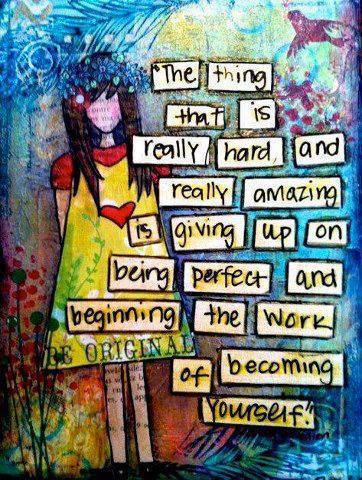
perfection-words-by-anna-quindlen

Perfection. Words by Anna Quindlen

The universe just gave us a hand.  It just knocked us flat on our collective ass so that we could go back to the drawing board. No more building houses on foundations of sand.  We have to change the way we think.  As a society, we have to create a new narrative based on Truth.   In this story line I imagine us still pledging ourselves to the justice of democracy for all, while acknowledging that we don’t always achieve our goals.  We have to grow beyond our tribal thinking.  We have to learn to think from a spiritual perspective, one that respects the basic unity of all life and the moral superiority of no one.

That said, the landscape before us at this point is looking pretty dark. At this point when we are all swimming in the ocean of confusion, getting back to the basics may be warranted.  So I have three things to say today about negotiating the Wintering of America.

First and foremost:  Do what you came here to do.  You choose this time.  On a spiritual level you made the decision to bring yourself back to Planet Earth during this time period which may be the most fascinating and crucial years in human civilization, apart perhaps from those brief 30+ years that Jesus of Nazareth walked on Earth.  You are here now for a reason.  Find your path.  Let your light shine brightly in these dark days.  The rest of us need that; and you need that.  Don’t let the chaos, anxiety and confusion of the world stop you from finding yourself.  It’s more important now than ever.  Your interests are of paramount importance to us all.  It’s still all about individual responsibility in a time when thousands of people are wanting to dictate what direction you should take.  Find your own Truth.  The God of your heart will tell you where to go, what to do, and what to be, if you just take the time to listen.

Second and also very important.  Do what you can with other people.  If you are a part of the Church of the Harvest, you are a big giver.  Most of you work with the public through your jobs in social agencies, government, private industry and the like.  You are all highly social people, committed to family and country, generous to a fault.  You already know what you can do FOR other people.  All of you are skilled at that.  Now figure out what you can do WITH other people.

Little known fact is that from a spiritual perspective, human beings are really at the very beginning stages of learning to work collectively in a genuine fashion.  We have not gotten much beyond survival mode.  We have learned to hunt together, necessary to bring down large mammals. We know how to band together to fight wars against other humans not a part of our immediate community whether it’s “playing politics” at a local level or waging conflicts and wars on a massive scale.  Humans have been very good at uniting AGAINST things.  As a species, we are still in elementary school when it comes to genuinely uniting FOR things.

inclusion

This is the time where the world must learn what it really means to be united in spirit while at the same time allowing for, even honoring and celebrating individual differences.  It’s about transcending the dichotomy, living the Truth, understanding that on a soul level you ARE the other; and they ARE you; and we ALL ARE aspects of the same God. . .at the same time that each of us is an individual soul with an individual mandate to follow the dictates of the indwelling God of our individual hearts.

You have a head start with this vital learning; and you can model for others.  If you are part of the Church of the Harvest, through your meditations you are committed to a process of manifesting the unity of spirit within a unique body. Figure out where you want to be giving and helping others and go for it, while never losing sight of your own path.  Work together with others whenever you can do so without undermining your own integrity.  Do what you can think to do but know that you can’t do it all because not everything will be on your path.  Support people who have found a different vantage point for their gifts, as best you can.  Speak up and lead righteously in the areas which have been given to you; and be a great witness, listener and supporter in the areas where others are on the forefront.

The model we all have for transcending the dichotomy of the individual soul living within the unity of all was given to us 2000 years ago by the Master.
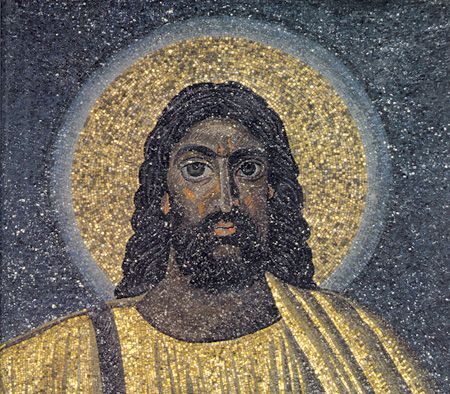
mosiac-of-jesus-in-a-church-in-rome-ad530

Mosaic of Jesus from a Church in Rome 530 ACE

Listen to the words of the Christ as he discusses the idea of the individual soul living as a part of all-that-is.  This is from Matthew, Chapter 23, and Verses 36-39.  Remember that when he talks about God he is talking about the Kingdom of God within each of us–not some old white dude in the sky.

Teacher, which is the greatest commandment in the law?

            Jesus said to him:  Love the Lord your God with all your heart

            And all your soul, and with all your might and with all of your mind.

            This is the greatest and the first commandment.


            And the second is like to it,

            Love your neighbor as yourself.


My third piece of advice is this:  Don’t be afraid of the wintertime.  We know that from a spiritual perspective there is no bad and good.  But we all have a tendency to fall prey to the perspective that winter is the not-so-good or even bad season.  Nature knows better.  All plant and animal life needs an extended period of rest.  In the Pacific Northwest we know that the very waters that sustain our life come predominantly from the snow that falls in the winter to recharge the aquifers.  Recognize the richness of the wintertime of dreaming up new futures, reflection and prayer.

Yes, some of Nature always dies in the winter, adding its carbon and other minerals back to the Earth so that other species will have room.   And with great regret I will confirm what you all know, a greater amount of life on Earth will be dying during this Winter than ever before, both human animals and nonhuman animals so that we all have a greater chance to find eternal life.  But from the big picture, from the mind of our Creator, it’s all good.  We need to hold that Truth in mind.

Again, words of the Master, from Matthew Chapter 24, Verses 10-13, in which he speaks about the “end times” that we are now experiencing:

Then many will stumble, and they will hate one another and betray

                    one another

And many false prophets will rise and will mislead a great many.

And because of the growth of iniquity the love of many will become cold.

But he who has patience to the end will be saved.

fireplace

Hunker on down.  It’s going to be a long winter.  Let’s keep each other warm.

Copyright 2016 by the Rev. Dr. Resa Eileen Raven

The Illusion of Time

From a Sermon given Summer Solstice Worship Service 2016

This fine morning I want to talk to you about time.  This sermon is a little more advanced than I usually present.  It is not something you are going to understand using your rational brain.  So please feel free to just let my words surround you, and awaken within you whatever is evoked by them and resonates.

At the Church of the Harvest, we try to focus on what makes you more aware of yourself as spirit.  Thus I have entitled my sermon the “illusion of time.”  Time, like everything else in the physical world is ultimately an illusion.  Time is an aspect of what in Indian culture is called the “maya.” Maya is a Sanskrit word.  In early Vedic writings “maya” referred to extraordinary power and wisdom, but as the concept developed over centuries “maya” came to be seen as the world always changing; and changing such that it becomes nearly impossible to see things as they really are.  In other words, “maya” implies the infinite reality of spirit that cannot be fully understood by human beings in terms of being contained by the human brain as it is presently constituted.

time3

Time is an illusion.  For you as spirit there is no time.  When your body passes away, you will leave the space-time continuum that exists on Planet Earth and return to the eternal heart of our Creator.  And when you come back to this Planet, assuming you will, you will again submerge into the time-space continuum that is necessary for the enormous power and wisdom that is you, to slow down enough to function in physical matter.

Time-space continuum.  That’s one of those phrases that people freely use, know there is some kind of truth to it, but don’t really know what it is.  You hear New Agers sometimes talk about the time-space continuum.  Or maybe you’ve heard about the concept from science fiction shows like Star Trek.  Some of the best descriptions of the time-space continuum come from the physical sciences.

einsteinmain

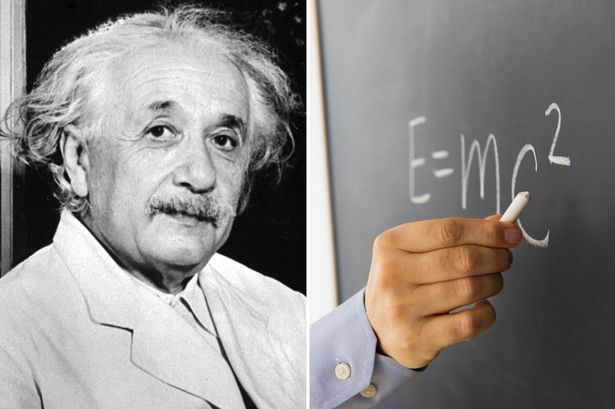
The time-space continuum burst into human consciousness primarily through the work of Albert Einstein, a man who was able to bring spiritual truths through scientific inquiry using mathematics, which he called the language of God.  Einstein taught us that time and space is actually the same thing, they exist on a continuum.  He challenged our views of time as static.  He talked about how an object in motion actually experiences time at a slower rate than an object at rest.

This is the kind of concept that the rational human brain has a hard time wrapping itself around.   Isn’t time always the same?  Well no, actually it’s not.  It changes.

time2

I was given the opportunity to learn about the non-static nature of time, the illusion of time, during the automobile accident in 1998 about which several of you have heard me talk.  I was horribly “late” for an event for which I thought I absolutely could not be late.  I was driving much too fast on a gravelly backcountry road, when I lost control at a sharp turn of the road and flipped the car.

These days nearly 20 years later, I rarely think about the miracle that I survived.  Or the fact that I was taken to the emergency room where the medical staff seemed to think there was something fishy about what the ambulance personnel were reporting after rescuing me from a ditch by the side of the road.  I not only had no broken bones, I didn’t have any lacerations or even any significant bruising.  They could not find anything wrong with me.

These days, what I often think about is the gift I was given that day I learned that time is an illusion.  I was thrown out the car window nearly fifteen feet away–so they tell me.  The car was totaled.  But what I experienced in a very visceral and real way was that time literally froze.  I can recall hovering above my body and spending what seemed to be many, many minutes “minutely” fine-tuning every muscle and curvature of my body so that it would land in EXACTLY the right way.   Apparently as spirit, I had decided it was not time to leave the body permanently or even damage it in order to learn what I set out to learn.  Instead, I raised my vibration level to such a rapid degree that time was unrecognizable so that I could position my body in the manner that would sustain minimal damage.

Time is an illusion. . .but it is a very powerful one, as I also learned that day.  I never allowed myself to drive at an excessive speed again, no matter how important a meeting was for which I was late.  Because time is an illusion only for spirit.  For the body, it is where we live. In the physical, there is only the present moment. And it is very important for the body that we live in present time.  As the science fiction author Ray Cummings has said, “Time is what keeps everything from happening at once.”  Can you imagine what it would be like if every thought you ever had, every emotion you’ve ever felt, every experience you have gone through all happened at the same time?  If you as spirit are not working within the body’s need for time (and space), all hell can break loose.

All lifeforms require that we work correctly with time.  When an animal is hungry, it needs to find food then, not some indeterminate time in the future.  If it does not, its very life is threatened.  When a plant needs water, it cannot be provided whenever.  The plant will wither and die if it does not receive water at the time when it needs it.  The reason I decided to talk about time today at our Summer Solstice service is because currently on our planet, all hell is breaking loose in large part because there are too many people not paying attention, or the right kind of attention to time.

We need to understand both the illusion of time and the fact that it is a powerful one which we have to take into account if we are going to manifest our essential nature as spirit here on Planet Earth.  We are here to learn about creating as spirit through matter, and there are several challenges that each of us need to meet for that learning to have an optimal outcome.

These days more and more people understand some of the basics about the space aspect of the time-space continuum.  In the United States we’ve been talking about codependency for several years now, which is just another way of people learning to work through their own space and not trying to work through others in the name of “fixing” them somehow.  We’ve been talking more and more about the importance of and what it really means to “consent” to sexual encounters.  And we increasingly dialogue about diversity, meaning that individuals can have a variety of different experiences that we need to respect with their free will within the context of a complex social fabric.

Most recently the entire world has been hot on the trail of trying to understand and diminish violence, whether perpetrated by gun-wielding haters, war mongers, bullies, human traffickers, exploiters of vulnerable others, or even the equipment that we use to protect (or not) the heads of football players.  We’ve been learning about economic, racial, sexual and other forms of inequality and privilege, and having national debates about how best and how much to help people that don’t have enough, without forcing them to live our chosen lifestyles.

These issues are all manifestations of trying to make sense of the dichotomy that as spirit, we are all one; but as a physical presence, we each have a body for which we are independently responsible.  These are not new issues.  Humans have tried to make sense of this paradox from the beginning of our time, but many people are on the verge of balancing these key dichotomies; and the space aspect of our physical existence that makes them so difficult to comprehend.

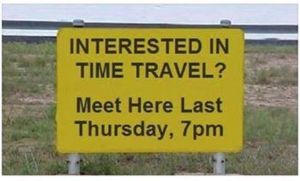
In my opinion, there has been less progress on the time aspect of the time-space continuum.  There is some interest in concepts like mindfulness, which is at its essence just a way to help people learn to live in the present moment.  But too many people have the vast majority of their energy tied up with the past, or the future; and are not very present in their actual physical body.  time-travel

When you are out of sync with yourself individually, that is to say when spirit is not creating in conjunction with the body’s need for time, at the very least you probably “waste” a lot of time; and at the worst you create pain and loss.  And YES, everything has a purpose, and YES, even the times of losing your way can help you learn. . .but do you really want to learn using pain and not joy as the vehicle for change?    53e6ead70d9c487e90883d8f579bd66f

When individuals are not in sync timewise—or as we say around here, having a body/spirit split—all kinds of disharmony is possible.  You can just waste resources, such as when people hoard a lot of material goods they don’t need  because they are living in past lives when they did not have enough; or trying to prepare for a future they can sense but can’t really see, where their fear says there will probably be less.  Some of the problem with hoarding includes the fact that people tend to be owned by too much stuff rather than owning it; and in the end excessive amounts of stuff usually deteriorates anyway if it is not being used.

Even if you don’t collect things when you are unaware of time, other disharmony is possible.  People can waste opportunities, opportunities that do not easily come again.  Some of the greatest regrets that are verbalized by those who are dying, are that they did not spend their time wisely, did not spend more time with their children or their family, did not travel, make music or art, or pursue some other dream.

In Erik Erikson’s final stage of human development, older individuals either integrate their life. . .or leave it feeling disgust with themselves and despair.  To put this in spiritual language, I can tell you that there is probably nothing more dehabilitating than getting to the endpoint with your body and realizing you have failed to learn what you came here this life to learn, failed to walk your path. . .and need to do it all again at another time.

Rest assured, I really have no fears about that level of disharmony with anyone present today.  You would not be here hearing my words unless you are closer to integrating body and spirit.  But I do have some concerns about our understanding of time as a society and as a world.  When many individuals are out of sync timewise—all kinds of disharmony are possible within our collective society. There are far too many people in key leadership positions, politically, economically, religiously, and throughout almost all of our other institutions that are living in the past or living in the future; and have no real ability to help with the problems of the present. confederate-flag-rally

In regards to the past for example, we have hundreds of people who still think they are fighting the civil war; thousands of Westerners who don’t even believe in past lives acting like they did when they were a part of the Roman Empire with all the world to subjugate; millions of people in other parts of the globe who are willing to wage war in a futile attempt to return their lifestyle to pre-industrial revolution days, etc.

preppers

And don’t get my started about people living in the future.  We can acknowledge the intense fear of preppers who are putting all their energy into a false notion that they alone will be able to meet our collective challenges by hiding away; along with the millions of Americans who believe that God will rapture them away from our sins against the planet.  It is hard to deny that those who are putting their energy into living in a future that will likely be very different from the one they expect are wasting their time.  As we used to say in the sixties, they are part of the problem, not the solution. When you stick your head, i.e. your consciousness in the sand like the proverbial ostrich, you are not helping the very real challenges we face together as a species.  Because the sad truth, my friends, is that the endpoint for human animals on Earth, as well as for many other animals is far too near.

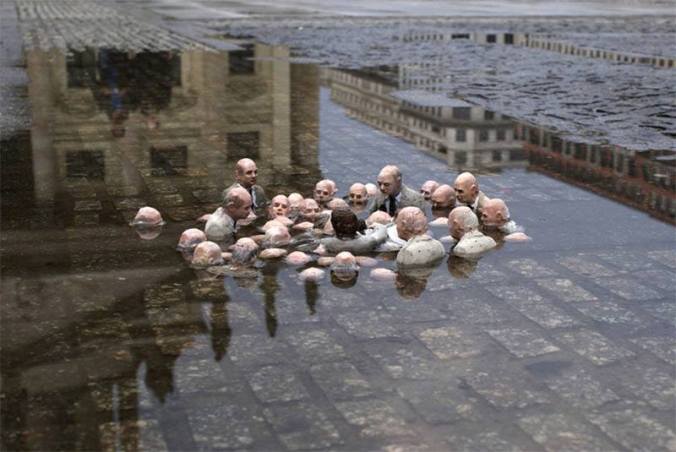
politicans-discussing-global-warming-sculpture-by-issac-cordal-berlin

Politicans Discussing Global Warming. Sculpture by Issac Cordal, Berlin

So what needs to be said to those of us who mostly understand space; and are beginning to understand time from a spiritual perspective?  Time is an illusion, but a powerful one.  Address it head on.  To the extent that you want to continue to operate as spirit on this gorgeous planet called Earth, please honor NOW the Mother Earth as our body-at-large, by increasing your awareness about time.  Be aware of the fact that collectively we are running out of Time. time-busyness

Please do not run my words through the programming so rampant in Western culture that you need to do more.  What I am saying is. . .in your individual life, do Time more wisely. For you, that might mean that you do less. Be in charge of the portion of Time you can control in your own space.  Use the techniques that you know to put spirit in charge of your own life more completely.  Ground for safety sake.  Center to bring you peace of mind and the ability to confront our challenges without getting lost to anger, grief, and/or despair.  Run your energy to clear sources of confusion and disharmony from your space.

Talk to the divine within.  Ask what you are spending your time on that you don’t need to be doing or thinking.  Ask what you are not spending your time doing or thinking that needs to be more of a focus.  Be still enough to listen for the answers.  And know that whatever changes you make as a result of these internal conversations will have a ripple effect, in some cases a major ripple effect, on all the people around you who are not similarly paying attention.

Some of these changes in how you spend your time will be big ones and some small.  Some will involve other people and some will not.  Join the human family with greater awareness, as we all learn more completely to be spirit in human form on Mother Earth.

Copyright 2016 by the Rev. Dr. Resa Eileen Raven
The Golden Rule

From a sermon given Summer Solstice Service 2002:

Today’s program is the second in our series this year focusing on the concept of peace.  My sermon this morning is about the Golden Rule.

The Golden Rule, of course, is the name that has been given to a very pivotal teaching in Christianity—the concept of doing onto others as you would have them do to you.

This concept is not unique to Christian-based religions.  We know that it comes from spirit because it is a truth that flows through most, if not all religious traditions and faiths.  I’ve collected a few versions of this same teaching from various religions to show you the universal nature of the Golden Rule.  I’d like to read these for you now.


Golden Rule

Hurt Not Others With That Which Pains Yourself.  (Buddhism).

Treat Others As you Would Yourself Be Treated.   (Hinduism)

What You Yourself Hate, Do to No Man  (Judaism)

Live in Harmony, For We Are All Related  (Native American)

Do Unto All Man As You Would Wish To Have Done Unto You (Islam)

One Word Sums Up the Basis of All Good Conduct:  Loving Kindness.  Do Not Do to Others What You Would Not Want Done to Yourself  (Confucianism)

As you can see, even the words are similar to the ones with which most of us are familiar, i.e. the words of Jesus of Nazareth.  This version is from Matthew, Chapter 7, Verse 12:

Whatever you wish men to do for you, do likewise also for them; for this is the law and the prophets.

Parenthetically, I think it is interesting that we have intuitively labeled this concept the Golden Rule.  If you think of it, very few of Jesus’s other teachings or sayings ended up acquiring a label.  And why this one?  Most people have very little awareness of the significance of this particular label.  What I believe is that one of the Christ’s greatest gifts to us was that he channeled to the Earth for the first time, a particularly high, miraculously healing vibration of energy, a vibration which when seen on a clairvoyant level appears golden in color.  I think the label itself tells us that the energy around the Golden Rule truly is something that if we accept it, transforms us, transforms our very bodies, our very souls, bringing us to a higher place.

Gold_Metal_Leaf_by_Enchantedgal_Stock

Although the words that Jesus used in the Golden Rule were traditional and familiar to people around the world during and subsequent to his lifetime, the energy behind them was new.  I believe that he did bring this spiritual truth to a new level.  In fact, his message was radical, even revolutionary.  And like many of the Christ’s teachings, 2000 years later we still struggle to have some genuine understanding of that to which he was referring with his simple words.  Spiritually based words are like that: straight-forward but so profound as to be endless in consequence and meaning.  To understand those words better, I would like to go back and tell you more about the historical context of them, particularly that part of the historical context that has been forgotten by those of us currently incarnated in twenty-first century United States.

Jesus was a Jew.  He was part of a society, a culture, a people who traditionally held lively, sometimes fierce debates among its members about all aspects of their religion.  There were several prominent sects of the Jewish people at that time and they were quite divergent in their beliefs.  The people tended to be very passionate about their belief system.  Arguing about differing ideology was the norm.  It was not uncommon for Jewish men to die for their beliefs, even though any particular Jewish man might hold ideas that were fundamentally different from another particular Jew within the same sect.  Nonetheless, most Jews came together as a people during holy times and worshiped in the same temple.

In modern America, we don’t really have an equivalent experience.  We might theoretically acknowledge, for example, that a Jehovah’s Witness, a Catholic, a Southern Baptist, a Seventh Day Adventist, and a Pentecostal are all Christians, but we would never come together at one worship service in the same church or temple at the end of the day.  When it comes to religion, our tradition is to go our separate ways and pretend the people with whom we don’t agree don’t exist unless we are badmouthing them in private company.

Jesus had the challenge of trying to reach all these conflicted, often argumentative, sometimes openly hostile people, Jews and non Jews alike, during the same public talks with his messages about love, peace, and the essential nature of God.  He tried to find words that would help his listeners transcend their surface differences and enter the world of spirit, where all is unconditionally accepted.  And he tried to do this with crowds who were often full of individuals quite determined to trying to pull him into fragmenting debates about religious dogma.

He was confronted for example by the Sadducees, who were a prominent Jewish sect that tended to approach sacred Jewish writings concretely and interpret them literally, in a similar fashion to how fundamentalist Christians often approach the Christian Bible in today’s times.  The challenge for Jesus, then, was to find ways to talk about traditional Jewish teachings that illuminated the spirit behind them without alienating people who, in their ignorance, wanted to impose their limited understanding of the words onto others in the form of rules.

Out of this dilemma came the teaching that we know as the Golden Rule.  This rule states that there are no rules as important as the mandate to love fully and unconditionally.  Let me read you the passage that I think best illustrate the master’s teachings in this regard.  It is from Mark, Chapter 12, Verses 30 and 31.  In this scripture, a man described in the Bible only as a “scribe” overhears Jesus during one of his public debates and thinks Jesus is giving good answers.  As a result, the man decides to ask Jesus a tricky question about Jewish law.  Of all the topics about which the Jews debated with each other, arguments about the extensive and frequently contradictory Jewish law often generated the most heat, the most calls for absolute adherence to whichever position the speaker upheld.  Jesus responded unequivocally with the following directive, a position that paradoxically is both absolute and flexible–read non-rule-bound–at the same time.

      You must love the Lord your God with all your heart and mind and with all your might; this is the first commandment.

      And the second is like to it.  You must love your neighbor as yourself. 

      There is no other commandment greater than these.      

What I hear Jesus saying is that the only thing that really matters is that each of us commit ourselves totally, that is commit all of our energy or what is referred to in this passage as our “might,” to God.  We are enjoined to make that commitment with the use of heart and mind.  In the words that we use around here in this church, we are advised to commit to the indwelling personal divine, the God of our Heart.

Glory Window at the Chapel of Thanksgiving, Dallas, Texas

Glory Window at the Chapel of Thanksgiving, Dallas, Texas

Further, Jesus tells each of us to commit ourselves totally to the unconditional acceptance and love of all around us.  Not just the nice people or the people who do things for us, or the people we know, but all those geographically near to us, i.e. all of those with whom we come in contact.  And he slips in a great Truth.  He articulates that loving the other folks in our world is pretty much the same thing as loving God.

Please notice the subtle underlying progression in his words.  I believe the movement of the sentence supports the idea that learning to love God completely leads to learning to love oneself as a child or aspect of God which in turn leads to loving other children/aspects of God.  But Jesus seems to say that sometimes you have to consciously commit to loving others. You can’t just wait until you’ve got it straight with God; and only then get around to taking on the task of improving your relationship to your fellow human being.  Even though ultimately, loving others is the natural progression of learning to love God, for most of us it takes a conscious choice, an act of willpower, to love some individuals in our world.  It can be hard work.

If we do these two things—follow the God of our Heart unfailingly, and love others unconditionally–everything else will fall into place.

During this period of strife in the world-at-large, let us take heed of the teaching of the master.  I urge you to use every opportunity to find the God within, both in and out of your meditations.   Translate the love that will naturally grow over time from alignment with our Creator to your thoughts, words, and actions towards the people in the world now, irrespective of whether or not they “deserve” it.  Don’t wait to love people until it is the easy next step in your development.  Do it now. Choose unconditional acceptance and care for the well-being of others, even the people that mistreat or abuse you.  The rest will take care of itself.

Copyright 2002 by Rev. Resa Eileen Raven

Angel of Peace Benediction

This prayer comes from the Essence Gospel of Peace, as excerpted by Edmond Bordeaux.

I will invoke the Angel of Peace

Whose breath is friendly,

Whose hand is clothed in power.

I give the peace of thy Earthly Mother

To thy body,

And the peace of thy Heavenly Father

To thy spirit.

And let the peace of both

Reign among the sons of men.

For my peace will strengthen thee and comfort thee,

For my peace is exceedingly full of joy.

Wherefore do I always greet thee after this manner:

Peace be with thee!

Do thou always, therefore, so greet one another,

And then wilt thou find peace also among thyselves,

For the Kingdom of God is within thee.

And give to every one thy peace,

Even as I have given my peace unto thee.

For my peace is od God.

Peace be with thee!

The Economy I: Where We’re Coming From

This article was written by the Rev. Resa Eileen Raven and published for the first time in March 2010 in a blog entitled “Ravings from the Rev”:

Last month Newsweek contained an interesting article that was called “May the Best Theory Win: How Economists Are Competing to Make Sense of Our Failed Financial System.” Basically the article was about how none of our existing belief systems can account for the current economic climate. They all are short of the mark, leaving those of us trying to weather the economy massively confused and frightened, and decision-makers clueless about how to get us out of the slump.

I always like it when the powers-to-be can honestly admit their ignorance, but the thing that really caught my eye was the article’s characterization of economists as doing a lot of “soul-searching.”

“Soul searching”–what an interesting choice of words. Maybe it is a stereotype of mine but I don’t think of economists as having much interest in or knowledge about soul. And yet. . .soul really is what is going on right now in regard to the economy.

To be fair, I don’t think those of us who have interested in soul for our part have had a lot of interest in the economy. There is a reason why Jesus of Nazareth talked about it being harder for a camel to go through the eye of a needle than a rich man to get into Heaven. . .and why, when he threw his one and only hissy fit of record, it was directed at a marketplace. Spiritually, you can lose yourself very easily if you get caught up in the exchange of money for goods and services. For many of us truly committed to our spirituality, focusing on money hasn’t been worth the risk. But I believe that this is the time for those of us who value the spiritual path to also learn to pay attention to economic issues, if for no other reason than to put them in their proper place.

For nearly two million years, human beings were tribal, nomadic, and completely preoccupied with survival in an immediate sense. It was primarily with the rise of early human civilizations some 8000 years ago, when we transformed from hunters/gatherers, that we developed the first “economies.” Farming the land, domesticating animals, constructing salt mines to preserve food, all these allowed people to have more than they needed at times, to accumulate “wealth.”  Folks could then trade with people outside of their own family/clan/tribe. Agricultural-based societies always eventually created a marketplace where people could swap things they did not want or need, with other things their neighbors offered.

marketplace

This production of “wealth” came with advantages and disadvantages. It had the obvious benefit of accumulating enough to meet the basics of life and a little extra to make life sweeter. It allowed individuals to exercise their God-given creativity. But it also provided opportunities for some to exercise greed, and/or exert control over their neighbors through the granting or withholding of resources, in a way that would not have been as tolerated in a more collectivistic hunter/gatherer society.

Anthropologists tell us that hunter/gatherer societies are almost always egalitarian in structure, whereas agricultural/industrial societies organize their members hierarchically. Counsels of elders and clan leaders eventually gave way to leadership by warlords and theocratic/civil governments who had the authority to intervene in human life but were often far removed from the real consequences of those interventions.   Whoever held the political reins could advance their economic interests to the detriment of others not in power, and they could do so without having to see, feel or hear from the people affected by their decisions.

For example, in 200 BCE, when the feudal kingdoms of China were united into one country, making China arguably the most advanced civilization on Earth at the time, its rulers could declare that all the iron and salt in the land belonged to them because they had to build a Great Wall to keep out the Huns. Businesses that needed iron had to pay exorbitant prices for it, forcing hundreds to lose their livelihood; and thousands of people who couldn’t afford the salt tax and therefore had no way of preserving food for the winter, were left to starve. This is one of the first of many examples of price-fixing and government monopolies leading to real suffering by those not at the top of the hierarchy.

salt pix

So what has this got to do with the economy today? Understand that there is a lot of history here, a lot of energy that has gone into our current economic dilemmas. We’ve been lost for a long time. For thousands of years, 8000 more or less, we’ve increasingly based our lifestyles, our political structures and our marketplaces on the acquisition of wealth and the physically-based needs that it can feed: glory, power, status, and hedonistic pursuits. Fair exchanges of goods and services in order to share with each other, has been an increasingly rare experience.

We’ve largely squandered the Earth’s once abundant resources, and have tried God’s patience enormously. During this time of great balancing, there is a lot to put right. And a lot of new ways of thinking will be required.

Copyright 2010  Rev. Resa Eileen Raven

Angels and Devils: The True Nature of Good and Evil

angels

From a sermon given September 2002 at the Fall Equinox Worship Service

When we originally picked the topic for this service, I had no idea it was such a controversial one. I just thought it would fun to look at one manifestation of a great roadblock that faces individuals and society as a whole who are trying to find peace. That is: the tendency of all of us to divide the world into good and evil.

Planet Earth really is a world of dichotomies; a vast playground full of polarized opposites. It is our job to notice these opposites and learn to choose the middle ground, the high ground so to speak. Other places in the universe do not provide this same challenge of polar opposites. The overarching defining principle of Planet Earth is that we have been gifted with free will. To maximize the learning process upon which we are all engaged, it is helpful for us to be presented with a wide range of opportunities so that we can learn to make choices that are productive and in keeping with divine intention. We are constantly given choices that involve one extreme or another. Thereby we can choose, if we want, to find the balanced perspective in between the extremes. That middle ground is where the peace lies, the inner peace for individuals; and the outward manifestation of it–the peaceful coexistence for groups of individuals.

The tendency for we humans to dichotomize runs so deep that we create situation after situation of “us versus them” in the world at large. As humans, our very brains become accustomed to, and find it most familiar to process the world from an either-or perspective. That same tendency runs deep enough in our basic makeup that we even dichotomize the world of spirit, much as we dichotomize the material world. Thus, in most religious traditions there exists angels, who are the good guys; and devils, who are the bad guys. Sometimes the latter are talked about as fallen angels, acknowledging that they are simply a point in a continuum; and sometimes they are seen as a class of villains by themselves with no particular angelic etiology.

It’s been many years since I looked at the concept of angels and devils. I deal with the spirit world on a daily basis, but I use other filters with which to view that reality. So to prepare for this sermon, and reacquaint myself with how many or most people think about angels and devils, I did what any good researcher would do: I watched a lot of movies.

There is a plethora of messages about the spirit world coming through these days. In this time and place, as the heavens and earth move ever closer together, and the basic fabric of the time-space continuum transforms, our culture is flooded with spiritual images and archetypes to which many people are exposed, often without any real awareness of what it all means. Angels and devils are everywhere in increasing amounts—not just confined to paintings in museums or gargoyles on structures built in medieval times; but on key chains and other knickknacks, and Hallmark cards, and on television, shoes, and rock songs. I am told, angels are mentioned in one out of every ten popular songs. However, movies are one of my favorite ways of tuning into popular culture, so I will start there.

There are some great movies out there that work us over on a subliminal level in a positive direction. I would recommend three in particular:  Michael, in which John Travolta plays a beer-drinking, ball-scratching, bull-fighting babe magnet as the Angel of Destruction. Then there is Devil’s Advocate, in which Al Pacino is a magnificent Lucifer trying to charm an attorney played by Keanu Reeves into fathering the Anti-christ. And my personal favorite is Dogma, a movie that was subjected to a concerted boycott by fundamental Christian groups, always a good sign. Armageddon is the main event in Dogma, with Ben Affleck and Matt Damon playing fallen angels, the talented Alan Rickman as one of the angels on the right hand of God, and George Carlin with a short stint as a Catholic cardinal who doesn’t even get that the battle is raging.

Hollywood movies, as fun as they are and as important as they are at both reflecting and shaping our thought processes, are considered only entertainment. So I also did research into how most people are viewing the subject of devils and angels by reading various serious popular and religious texts. And that’s where the real fun begins. Because, as with most aspects of spirituality, people are all over the map. There is no consensus about the nature of the spiritual beings we call angels and devils.

As it turns out, the Christian Bible, that ultimate source document for many people in the United States, is strangely quiet on this subject. Although there are a number of references to angels, there are very few actual details contained therein. In the accepted scriptures of the God of the Judeo-Christian tradition , there are angels who exist to worship God, and angels who are sent out by him to protect, destroy, or carry messages to mankind. But we do not know much about who these beings are, where they live, or what they typically do in an ordinary angel day. There are only two angels who are actually named in the Bible: Michael, and Gabriel. This is not very much information about beings than are generally considered to be more numerous than the stars. I am told that in the 14th century, the number of angels was calculated by certain segments of Christianity as numbering 301, 655, 722.

Information about devils in the Bible is also largely or wholly missing. Satan is mentioned sporadically. In the Old Testament he is more in the role of a prosecuting attorney in ongoing theological debates than an evil figure. In the New Testament, he is certainly not the tunnel-visioned, stand-alone, cartoon-like figure that is portrayed by many present-day Christians.

For example, in Matthew, Chapter 17, Jesus of Nazareth has a disagreement with Simon Peter. This is directly after Jesus has told Peter that Peter is the rock upon which Jesus’s church will be built, so obviously within the context of Jesus having a great deal of faith in Peter and his abilities. Jesus tells his disciples that he will soon be crucified, and Peter tells Jesus that this isn’t going to happen. Jesus says to Peter, you are thinking from the ways of man, not God; get out of the way, Satan. What I hear from this story is Jesus’s acknowledgment that even the strongest and brightest of us can have energy not aligned with God. I do not hear validation for a separate being which we might simplistically call “the Devil.”

There is actually, a lot of information about angels and devils out there in popular literature and apocryphal or noncanonical literature, but none of the world’s religions seem to have a consistent, coherent stance on the subject. In polytheistic systems of religious belief, there seems to be more mention of but less focus on angels and devils, probably because when you base religions on inward meditation and not outward-based truth-seeking, you have less need for intermediary spirits between an individual soul and the Cosmic Consciousness.

In all the great monotheistic religions, devils and angels galore exist, but also a great deal of controversy about them, even within each church or religious denomination. Even in Hinduism, Buddhism, Jainism, and the like, there are many acknowledged spirits or devas that pursue out good or bad ends.

At various times in various ways Jews, Christians, and Muslims have all gone through periods of awakening interest in the functioning of the spirit world; followed by periods of anxiety that acknowledgement and exploration of the spirit world will lead to an undermining or destruction of faith in the teachings of the church; followed by further periods of rediscovering sacred literature about angels and devils; followed by further rejection by church leaders in the populace’s interest in these entities, etc.

For the record, I will tell you that personally, I do believe that there are spirits that will assist us in following God’s will, if we choose to avail ourselves of their assistance, spirits that might accurately be labeled “angels.” In the words of the 91rst Psalm, Verses 10-11:

He will give his angels charge of you,
To guard you in all your ways.
On their hands they will bear you up,
Lest you dash your foot against a stone.

I don’t know about you, but I am very prone to dashing my feet against stone, and consequently am quite glad for the assistance of the spirit world, which I receive freely when I remember to call upon them.

I also believe that there are spirits who are more than willing to encourage us in making choices that are detours on our path back to God, many who are simply curious or mischievous; and a few that rise to the level that might be called evil. The former could be called devils and the latter “the Devil,” if you prefer that terminology.

Ultimately, however, it is our choice who we hang out and allow around us, and who we follow–whether they have a body they work through or not. Because we have free will. We demand of the substance abuser that if they claim to be sincere in controlling their drug-seeking behavior, they must surround themselves with those who will support patterns of sobriety and other pro-social behavior. So too, is it up to us to surround ourselves with those who will lead us to the righteous pathway. When we can acknowledge the self-responsibility that derives from our free will from a place of awareness and a place of nonjudgment, than we can make clearer and more productive choices that are the more direct route to the true peace that comes only from connection to our Source.

So what is the True Nature of Good and Evil? You know me. Of course, I’m not going to impose my truth upon you. Feel free to discover your answers in your meditations over time. But I would like to leave you now with an interesting tidbit I ran across in my research. According to Malcolm Godwin, who wrote a book called Angels:  An Endangered Species, among the stories about the war between the angels in heaven in various Christian texts, there was one version that was suppressed by the Catholic Church. In this version of genesis or the apocalypse or whenever this war supposedly takes place, there were three groups of angels, not two. One-third sides with God, one-third with the Devil, and one-third chooses to stay out of the conflict. Reportedly it was this third group of angels, the ones who chose neutrality, the not-very-bad but not-very-good-ones, who later bring the Holy Grail to Earth.

Copyright 2002  Rev. Resa Eileen Raven

Simplicity

From a sermon given March 2000 at the Spring Equinox Worship Service

simplicity

Back in the dark ages, when I was in my late 20s and beginning to focus on my spiritual development, I had a teacher who said to me once, Eileen, you do understand, don’t you, that simplicity is a spiritual concept? I remember looking at her with what I’m sure was a puzzled expression on my face, tilting my head to one side and just listening. With all the new information to which I was being exposed about how the world of spirit works, listening was often all I could do in those days. Really, I didn’t have a clue what she was talking about then. I knew what she was saying sounded right, but I wouldn’t have been able to tell myself or anyone else why.

In those days, I was still revealing in the freedom of a life I was creating entirely on my own, beyond what I had known for so many years in my family of origin. I was filling my life with new experiences, some constructive, some destructive, but all ones that I craved–experiences I had not been able to have living with my parents. I was stacking my days with places I had never been allowed to go, activities that I had never done before, relationships with people who sometimes weren’t the kind of people my parents would approve of, joining groups that were beyond my family’s and sometimes even society’s norms. It was all pretty thrilling. Sure I was exhausted, chronically sleep-deprived, emotionally unstable most of the time, financially irresponsible, but I felt alive! I was living the loca vida and it felt great.

It probably was a good thing that I didn’t have the words to respond to my teacher talking about simplicity, because the words might have been the unproductive, argumentative kind. Because for me, at the time and place in which my attention was first drawn to the concept of simplicity, what simplicity really meant was boredom. A simple life, in my immature view, was one that was devoid of meaning, one that didn’t have much going on, a state of deprivation.

I tell you about my earlier view on simplicity because I think it is one shared by a lot of people, particularly in American culture. Of course, young adults often have the need to explore the external world in new ways beyond what they have known in childhood, and this is a legitimate developmental phase. Each new generation has a tendency to accuse the last one of being insulated to the point of being boring. But it’s not just youth that equate simplicity with boredom. I think many people believe, at least on some level, that simplicity is for fools, for people who can’t get it together enough to create an interesting life. According to this view, the simple life is for those who are dull by nature, fearful, or who simply don’t mind being stuck.

On the other hand, there are many people who believe the opposite. On Planet Earth, we like to learn through dichotomies, so there are also a great number of people running around who believe that simplicity is not only a good thing, it is the solution for all of life’s woes. These are the people who are nostalgic for the “good old days.” The idea here is that life used to be simple, and now it is not, and a great deal of what is wrong with the world would be corrected if we could simply go back to the time when things were simple. I am always amused by the capacity we have as humans to idealize situations which were not really ideal. Returning to one’s childhood which did not have the responsibilities we face as adults, but usually had other more invisible responsibilities equally challenging, is not the solution. And as a society, returning to times when technology was at a minimum, is not the solution for our collective problems. As you all are probably aware, you can only truly solve problems from present time. You can never really resolve anything by living in the past.

What I find particularly interesting about the “nostalgia” view of simplicity is that it is generally not grounded in reality. I don’t think that life on Planet Earth has ever been simple, at least for the vast majority of people. Of the 800 to 900 or so generations of human beings that have passed through this plane, nearly 700 of those generations have lived in caves, and have been preoccupied during nearly every waking minute of each day with the task of gathering enough food, clothing, and heating fuels to survive. There’s nothing particularly simple about a life in which it takes enormous concentration to bring down a mastodon with wooden spears tipped with flint, or wander to the right area that may allow you to scratch out edible roots when you don’t have any solid information about geography, upcoming weather patterns, or how to stop the bleeding if the mastodon catches you before you catch it.

And what about our last few generations, when we have had increasing amounts of technological information at our disposal? Are our lives now simple because we have more information about how the physical world works? You can find people who tell you that technology has, indeed, made life much simpler. And you can find people who insist that technology has made life much more complex. For the first time in human history, there are large numbers of people in the world who are not solely and totally preoccupied with survival. We actually have something called “leisure time,” which has only been around for less than a hundred years or so. Now that many of us can choose how we want to spend at least some of our time, is our life more simple, or less simple? And even more fundamentally, does it matter? Should simplicity be the goal? Is living a simple life a virtuous thing, is it simply settling for less than is possible, or is it different for different people? And what is simplicity, anyway? (So, now we’ve come full circle in this discussion).

All I can do is tell you a little about my experience, as a person committed to using meditation as a means of connecting with my inner world with the creative force that lives within me, as it does within us all. As the months have gone by in which I spend more time acknowledging what is going on within me, I become less driven by the world around me. My outer world still interests me, in some ways more than ever, but I am less hooked by it, less attached to it. As a result, lots of material things, certain experiences, and even some relationships that used to command my attention, have simply ceased to be important to me. They’ve just fallen away. And other things, experiences, and people in the physical world have become more important to me, but somehow in a way that is effortless.

I’m actually busier now than I’ve probably ever been in my life. These days I have more businesses going, clients, personal friends and projects that I’m working with than I did in my entire 20s and 30s. To an outside observer, my life looks very hectic. But in actuality, I’m getting all the sleep, rest and leisure time I need, and I feel at peace most of the time. Because the people and the resources just show up when they need to and the experiences happen as they happen, and it is all very simple. My life is very simple. My lifestyle is extremely complex. If you can understand how those two things can both be true, than you are well on your way to understanding why simplicity, true simplicity, is indeed, a spiritual concept.

Copyright 2002   Rev. Resa Eileen Raven